Balancing Measures:
Best Practices in Performance Management
August 1999
CONTENTS
- Executive Summary
- Prologue
- Balancing Measures: Why Should I Do It and What Does It Mean?
- Summary of Best Practices in Balancing Measures
- Section 1: Establish a Results-Oriented Set of Measures That Balances Business, Customer, and Employee
- Section 2: Establish Accountability at All Levels of the Organization
- Section 3: Collect, Use, and Analyze Data
- Section 4: Connect the Dots
- Section 5: Share the Leadership Role
- Balancing Measures: Next Steps
- Appendices
Executive Summary
When the Government Performance and Results Act was first implemented, many felt that government management was somehow "different," that the same rules that applied to the private sector could not apply to the public, or at least not in the same way. After all, government agencies don’t have a bottom line or profit margin. But recent efforts, as this study shows again and again, attest that is not true. The bottom line for most government organizations is their mission: what they want to achieve.
But they cannot achieve this mission by managing in a vacuum, any more than can the private sector. More specifically, the roles of customer, stakeholder, and employee in an organization’s day-to-day operations are vital to its success—and must be incorporated into that success.
In their groundbreaking Harvard Business Review article, Robert S. Kaplan and David P. Norton introduced the concept of the Balanced Scorecard to the private sector. This article, and subsequent works by them, discusses private sector efforts to align corporate initiatives with the need to meet customer and shareholder expectations. This study looks at how these efforts relate to, and are being replicated within, the public sector. It examines the ways and means by which government organizations are trying to include customers, stakeholders, and employees in their performance management efforts—to reach some balance among the needs and opinions of these groups along with the achievement of the organization’s stated mission. All of the organizations that served as partners in preparing this report have had some level of success in doing this.
Our partners believe that, while there is no perfect fit of the Balanced Scorecard as envisioned by Kaplan and Norton with performance planning, management, and measurement within the public sector, this does not mean that the concept isn’t useful in government planning—particularly with some tinkering and tailoring. So, public sector organizations with the most mature strategic planning processes—notably city and state governments—felt that the area of employee satisfaction, for example, translated better to the public sector when seen as employee empowerment and/or involvement.
Defining who exactly the customer is can be a challenge for government agencies, especially for federal agencies with more than one mission. For example, the U.S. Coast Guard has both an enforcement and a service mission—and consequently different customer bases. And even those agencies that have but a single mission, such as regulatory agencies like the Environmental Protection Agency, must take into account not only those with whom they deal on a day-to-day basis in their enforcement activities, such as major manufacturers, but also the citizen who is being protected by those enforcement activities. And the organization that provides a service or benefit, like the Social Security Administration, must distinguish between what the customer may want and what U.S. citizens may be willing to spend: that is, to balance their fiscal responsibilities to the taxpayer with their responsibilities to beneficiaries.
Other important lessons about balanced performance measurement gleaned from site visits and interviews with our best practice and resource partners include the following:
- Adapt, don’t adopt: Make a best practice work for you.
- We aren’t so different after all: Public or private, federal, state, or local, there are common problems—and common answers.
- Leadership doesn’t stop at the top, but should cascade throughout an organization, creating champions and a team approach to achievement of mission.
- Listen to your customers and stakeholders.
- Listen to your employees and unions.
- Partnership among customers, stakeholders, and employees results in success. Telling—rather than asking—these groups what they need does not work.
Why should you, a government leader, try to achieve a balanced set of performance measures—or what’s often referred to as a family of measures? Here’s what we found in our research: Because you need to know what your customer’s expectations are and what your employee needs to have to meet those expectations. Because you cannot achieve your stated objectives without taking those expectations and needs into account. Most importantly, because it works, as can be seen from the success of our partners.
So you need to balance your mission with customer, stakeholder, and employee perspectives. How exactly do you go about doing this? These are the best practices we learned from our partners.
Establish a Results-Oriented Set of Measures That Balance Business, Customer, and Employee
- Define what measures mean the most to customer, stakeholder, and employee by (1) having them work together, (2) creating an easily recognized body of measures, and (3) clearly identifying measures to address their concerns.
- Commit to initial change by (1) using expertise wherever you find it; (2) involving everyone in the process; (3) making the system nonpunitive; (4) bringing in the unions; and (5) providing clear, concise guidance as to the establishment, monitoring, and reporting of measures.
- Maintain flexibility by (1) recognizing that performance management is a living process, (2) limiting the number of performance measures, and (3) maintaining a balance between financial and nonfinancial measures.
Establish Accountability at All Levels of the Organization
- Lead by example.
- Cascade accountability: share it with the employee by (1) creating a performance-based organization, (2) encouraging sponsorship of measures at all levels, and (3) involving the unions at all levels of performance management.
- Keep the employee informed via intranet and/or Internet; don’t rule out alternative forms of communication.
- Keep the customer informed via both the Internet and traditional paper reports.
- Make accountability work: reward employees for success. Supplement or replace monetary rewards with nonmonetary means, reallocate discretionary funds, and base rewards in a team approach.
Collect, Use, and Analyze Data
- Collect feedback data, which can be obtained from customers by providing easy access to your organization; remember too that "survey" is not a four-letter word.
- Collect performance data by (1) investing both the time and the money to make it right, (2) making sure that your performance data mean something to those that use them, (3) recognizing that everything is not on-line or in one place, and (4) centralizing the data collection function at the highest possible level.
- Analyze data: (1) combine feedback and performance data for a more complete picture, (2) conduct root-cause analyses, and (3) make sure everyone sees the results of analyses.
Connect the Dots
If your performance management efforts are not connected to your business plan (which defines day-to-day operations in a government agency) and to the budget (which is where the money is), then you will be doomed to failure because your performance measurement approach will have no real meaning to the people running, or affected by, the program. Planning documents must connect to business plans, and data systems and the budget process must be integrated with all these other factors. By doing so, you can create a strategic management framework which serves to focus the entire organization on the same mission and goals.
Share the Leadership Role
Leadership is a critical element marking successful organizations, both public and private. Cascaded throughout an organization, leadership gives the performance management process a depth and sustainability that survives changes at the top—even those driven by elections and changes in political party leadership. Two experts in the field, the Hon. Maurice McTigue, a former New Zealand cabinet member now working at George Mason University, and Dr. Patricia Ingraham of the Maxwell School at Syracuse University, emphasize in their teaching the importance of leadership in a political environment. Given the potential constraints such an environment can present, a successful public sector organization needs strong leadership that supports the adoption of balanced measures as a feature of organizational management and accountability.
Prologue
The U.S. Postal Service (USPS), once considered outdated and inefficient, now has a reputation as a good place to work and an on-time delivery rate of over 90 percent; also, it has registered an increase of over 20 percent in customer satisfaction.The U.S. Coast Guard has shifted from a perspective of regulatory enforcement to one of problem mitigation by building a plan of compliance through strong partnerships. This emphasis, reflected in a commitment to prevention and partnerships with industry, has resulted in about a 50 percent drop in both the overall average number of large oil spills (those that are more than 10,000 gallons) from pre-1991 levels and volume of oil spilled.
From employee and customer surveys, the Bureau of Land Management (BLM) found that increases in employee satisfaction correlated to increases in customer satisfaction on almost a one-to-one basis. BLM has responded to its customers by developing a one-stop website for federal recreation information and by consolidating its permitting processes.
During the first year that the Florida Department of Environmental Protection reviewed and measured performance data, 46 focus areas were identified, and resources were allocated toward improving these areas. By the end of the first year, there was improvement in 29 (63 percent) of these areas.
The first U.S. city to adopt a balanced measures approach was Charlotte, North Carolina. That city has operationalized their vision to be a "model of excellence that puts the community’s citizens first, where skilled, motivated employees are known for providing quality and value in all areas of public service" into the elements of their corporate scorecard. Charlotte reports that implementing a balanced scorecard approach has helped to integrate common goals across departments and build consensus and teamwork throughout the organization.
The Department of Housing and Urban Development (HUD), after years of difficulties, today begins to see improvements in customer involvement, employee morale, and overall confidence in the department as a whole.
What are these agencies doing right? For a start, they have at least four things in common:
- an urgent need to change—and change dramatically—the way they do business,
- employees who believe in the service they provide and take pride in doing a good job,
- customers and stakeholders who want to work with them to everybody’s benefit, and
- a strong leader who believes in listening to and respecting the opinions of customer, stakeholder, and employee.
These organizations have achieved some measure of success by balancing achievement of successful business results with provision of good service to customers and provision of appropriate tools for employees to do their jobs well. They are trying to balance these three often competing demands to create a high-performance organization.
Why Did We Do This Study?
For many years, leaders at all levels in the private and public sectors have searched for the right tools and techniques to help them create high-performing organizations. The Balanced Scorecard introduced in 1992 by Kaplan and Norton of the Harvard Business School galvanized and revolutionized the field. The Balanced Scorecard approach to performance management gained wide use and acclaim in the private sector as a way to build customer and employee data into measuring and ensuring better performance outcomes. It thus transformed the way private sector companies could achieve and analyze high levels of performance and was critical in revitalizing such companies as Federal Express, Corning, and Sears.
In August 1993, Congress passed the Government Performance and Results Act (referred to as both GPRA and the Results Act). Under GPRA, leadership in the public sector was legally obligated to address issues such as performance planning and management—as well as report on the results of those efforts. Many felt that government management was "different," that the rules of performance management and measurement that applied to the private sector could not apply to the public. After all, government agencies don’t have a bottom line or profit margin.
Recent efforts have shown, however, that not only do the basic concepts apply to the public sector, they can also be used to create a successful organization. For example, agencies may not have a financial bottom line, but they do have goals and outcomes that can indicate success (e.g., reduction in pollution).
Other concepts apply as well, as was borne out by Executive Order 12862, signed by President Clinton in September 1993. This order requires federal agencies to determine from their customers the kind and quality of service they seek. In the same way that the private sector experienced noticeable changes by measuring beyond business results, government agencies have also begun to balance a greater constellation of measures by incorporating customer needs and expectations into their strategic planning processes. This balanced approach to performance planning, measurement, and management is helping government agencies achieve results Americans—whether customers, stakeholders, employees, or other—actually care about.
Cities, states, and counties have actively adapted the balanced measures approach. Some federal organizations too have begun to pursue balanced measurement as part of ongoing efforts to improve efficiency, effectiveness, and customer service in their organizations. Abroad, similar activities have been taking place. The British government formed the Performance and Innovation Unit to, among other things, "promote innovative solutions that improved the effectiveness of policy, the quality of services and the responsiveness to users’ needs." Also, the Service First Unit in the UK has been focusing on customer service issues for several years. Many Canadian government agencies—including Natural Resources Canada, the St. Lawrence Seaway Management Corporation, Atomic Energy of Canada, Ltd., and the Trademarks Office—have been working to link their customer service, performance management, and budget processes together.
At a time when new performance, budget, and strategic challenges to the public sector affect its current and future decisions, much can be gleaned from these various experiences with balanced performance measurement. Thus, Vice President Al Gore—after hearing three highly successful and diverse corporate leaders at a reinvention forum attribute balanced measurement of performance as critical to taking their companies to the top—charged the National Partnership for Reinventing Government (NPR) with identifying and studying best practices in using balanced measures in the public and private sectors.
How Did We Do This Study?
NPR chartered a team comprised of federal, state, and local agency managers and staff. These team members worked with study partners from all levels of the U.S. government as well as from international agencies and the private sector.
This report represents an extensive undertaking to survey and interview agencies and companies for practices that contribute to improving service as well as business results. Our findings show that the road taken—the process followed—has not been exactly the same in every instance. The results, however, have been remarkable. Balancing business results with customer, stakeholder, and employee information generally produces marked improvement in performance, service, and overall satisfaction. Our study partners report gains in efficiency, data tied to strategic goals and measurement systems, and improved relationships with employees and customers.
The team reviewed extensive literature on the subject, both on-line and in hard copy. Screening surveys were developed and sent to over 100 organizations. We completed more than 30 case studies, either through site visits or telephone conferencing. These are linked in the web version of this report and provide extensive data. At the end of each site visit report is contact information for that organization for futher follow up. For a complete description of our scope and methodology, see appendix A. Our best practice partners and resource partners are listed in appendices B and C, respectively.
This report is divided into basic areas of performance planning and management:
- creation of measures (section 1);
- need for accountability (section 2);
- use of data (section 3);
- linkage of all the aspects to day-to-day operations (section 4); and
- the role of leadership in the evolution of solid, sustainable management practices within an organization (section 5).
Each section discusses how to balance customer needs, employee needs, and business results.
Most of our state and local partners belong to the Performance Measurement Consortium of the International City/County Management Association (ICMA). Collecting and reporting data on ICMA’s templates has enabled one notably successful partner, the city of Coral Springs, Florida, to compare its outcomes against those of a number of other communities (http://www.icma.org/abouticma/). Service areas evaluated under the city’s program include police services; fire services; neighborhood services (e.g., libraries, parks and recreation, refuse collection, road maintenance, and street lighting); and support services (facilities management, fleet management, human resources, information technology, purchasing, and risk management). A fifth service area, youth services, is under development.
Lessons We Learned
Overall, a balanced approach to performance measurement works and will improve organizational performance when used. Flexibility is the key. There is no "cookie cutter" approach, but there are elements and experiences reported here that can be useful and beneficial to all agencies.
- Adapt, don’t adopt. A best practice generally cannot be adopted exactly the way it was done in another organization, but it can be adapted to fit your organizational needs and culture. Most of the organizations we interviewed have adapted the traditional Balanced Scorecard into a family of measures that is uniquely suited to their culture, their structure, their mission. In the final analysis, you must adapt an approach to fit your particular needs.
- We aren’t so different after all. One of the most interesting discoveries for the team was the fact that the problems the different organizations were facing weren’t very different. Most struggled with the same issues: reducing the number of measures, validating and verifying data, establishing accountability and responsibility without being punitive, and—most importantly—trying to balance achievement of the organization’s mission with the needs of customer, stakeholder, and employee. In many cases, merely defining the customer was an obstacle. Public or private, federal, state, or local, there are common problems—and common answers—in many areas.
- Leadership doesn’t stop at the top. Leadership is important, but not just at the top levels; leadership by employees in solving problems and achieving mission is what makes for a most successful organization.
- Listen to your customers and stakeholders. You might be surprised to learn what is really important to them. The Oregon Department of Motor Vehicles was prepared to spend money on ways to provide faster service and shorter lines. Then it asked its customers what they wanted. They wanted a choice in the ID picture that would be laminated onto their license. Oregon listened and invested in better photographic equipment and provided a choice to the customer as to the picture to be used.
- Listen to your employees and unions. Employees have historical knowledge and experience at the day-to-day operations level. Don’t underestimate the importance of this information and expertise. And, regarding the union, if it is part of the solution, it is no longer part of the problem. This precept is especially critical in achieving culture change within an organization.
- Partner with customers, stakeholders, and employees; don’t control. The more you partner with those who have a vested interest in the success of your organization, the more successful your organization is likely to be. Some of the most successful organizations work closely not only with customers and employees, but also with unions and legislators. Better communication results in an increased level of trust.
Most importantly, we learned that there is no such thing as a fixed and truly balanced set of measures; instead, the process of balancing the needs of customers and employees against mission is a constant and living one, flexible and open to change.
The team learned a great deal from this study; we are pleased to share this knowledge with you. The practices listed here can be used, adapted, and implemented throughout the public sector. We hope this report will be seen as a tool to help everyone do their job better and more efficiently.
Balancing Measures: Why Should I Do It and What Does It Mean?
"Reflecting back on the long history of federal service, I never saw any single measure which could adequately describe an agency’s performance. Use of the ‘scorecard,’ because it balances both internal and external stakeholder concerns, gives us a much more comprehensive, and balanced, picture of how we are doing. The measures we traditionally used tended to focus almost exclusively on internal processes. They also failed to measure three major areas: the real cost of doing business, the impact of the processes on the veteran-customer, and their impact on employees. Use of the scorecard balances our measures because it looks at both external and internal measures. They keep the organization focused on the vision and our stakeholders: veteran-customers, employees, and taxpayers. The scorecard measures provide a ‘line of sight’ for every employee to see their contribution to organizational results." —Joe Thompson, Under Secretary for Benefits, Veterans Benefits Administration, Department of Veterans Affairs
Balancing measures is a strategic management system for achieving long-term goals. Senior executives in industries from banking and oil to insurance and retailing use balanced measures to guide current performance and plan future performance. They use measures in four categories—financial performance, customer knowledge, internal business processes, and learning and growth—to align individual, organizational, and cross-departmental initiatives and to identify processes for meeting customer and shareholder objectives.
Their experience has shown that balancing a family of performance measures works. This means that in each phase of performance planning, management, and measurement, the customer, stakeholder, and employee are considered in balance with the need to achieve a specific mission or result. This approach has worked in the private sector and is beginning to take firm root in government as well. While there is no exact formula for applying balanced measures, the goal of this report is to provide options and courses of action for use in and across the federal government. The experiences of those who have begun to use balanced measures provide opportunities for agencies to read about what has been successful for others, to choose applicable practices, and to improve performance to match the best in the business.
Are You a Driver or a Pilot? Instrument Panel Versus Dashboard
Using balanced measures allows you to mirror the factors that you believe are critical to the success of your organization. "A good way to understand the balanced scorecard is to imagine yourself as the captain of a jumbo jet," write Robert Kaplan and David Norton in their groundbreaking article on the management tool in the Harvard Business Review. They continue:
Imagine the flight deck and all the instruments, dials and gauges on the panel in front of you. These instruments tell you about the various parts of the plane and how it is flying. Reliance on the altimeter only would be foolish—you might know your altitude, but you wouldn’t have any warning about impending storms. You wouldn’t look only at the radar, of course—how would you know when you were low on fuel?
Balanced measures serve as an instrument panel for your organization. They provide important information from different perspectives, creating a holistic view of the organization’s health. They bring together on a single management report many of the disparate elements of the organization’s agenda.
Another useful metaphor in discussing a balanced approach to performance management is the dashboard approach. Management, when resistant to change, will often complain that it cannot focus on everything at once, that the "powers that be" need to make up their mind about exactly what it is the leader is to look at. The answer to this is that being a good leader is like driving a car. After all, there are many gauges on the dashboard. While you are driving, you take note of the level of fuel (you don’t want to run out of gas). You watch the water level (you wouldn’t want to overheat the engine). And if an emergency light were to come on, you would notice that as well. These all are secondary observations, however, to the driver’s primary focus of moving the car safely in one direction while watching for obstacles in the road, including other drivers. That is exactly what a good leader in an organization should be doing. A balanced set of performance measures is like the gauges on the car; the mission is the destination.
Why a Balanced Approach?
Regardless of which metaphor you embrace, a balanced approach allows you to consider all the important operational measures at the same time, letting you see whether improvement in one area is achieved at the expense of another. Key indicators should tell you how the organization is doing. They will probably change over time to reflect shifting organizational goals. Performance levels can be reported on a monthly or quarterly basis. All levels of management, including field personnel, can participate in the reporting process; together, they provide a good idea of the health of the organization from a variety of perspectives. It is only with a balanced approach that leaders can create success throughout their organizations.
This proven approach to strategic management imbeds long-term strategy into the management system through the mechanism of measurement. It translates vision and strategy into a tool that effectively communicates strategic intent, and motivates and tracks performance against established goals.
A strategy is a shared understanding about how a goal is to be reached. Balancing measures allows management to translate the strategy into a clear set of objectives. These objectives are then further translated into a system of performance measurements that effectively communicates a powerful, forward-looking, strategic focus to the entire organization. In contrast with traditional, financially based measurement systems, the balanced measures approach solidifies an organization’s focus on future success by setting objectives and measuring performance from distinct perspectives. The old method of management, which focused only on the bottom line, no longer works. If the customer, stakeholder, and employee are not part of the solution, they will forever be part of the problem.
Balanced Across What Perspectives?
You need to look at your performance management from three perspectives: employee, customer, and business.
The employee perspective focuses attention on the performance of the key internal processes that drive the organization. This perspective directs attention to the basis of all future success—the organization’s people and infrastructure. Adequate investment in these areas is critical to all long-term success. Without employee buy-in, an organization’s achievements will be minimal. Employees must be part of the team.
Examples of Concerns From the Employee Perspective
- How do you get employees to see the federal government as an employer of choice?
- Focus on issues such as employee development and retention.
The customer perspective considers the organization’s performance through the eyes of a customer, so that the organization retains a careful focus on customer needs and satisfaction. For a government entity, this perspective takes on a somewhat different meaning than for a private sector firm; that’s because most public sector organizations have many types of customers. The private sector recognizes the importance of the customer and makes the customer a driver of performance. To achieve the best in business performance, the government, too, must incorporate customer needs and wants and must respond to them as part of its performance planning.
Examples of Concerns From the Customer Perspective
- How do you want your customers to view you?
- Who are your customers? Is there more than one group?
- Are measures based on external customer input?
- Do your measures reflect the characteristics of good service (accessible, accurate, clear, closure, timely, respectful)?
The business perspective, like the customer perspective, has a different interpretation in the government than in the private sector. For many organizations, there are actually two separate sets of measures: the outcomes, or social/political impacts, which define the role of the agency/department within the government and American society; and the business processes needed for organizational efficiency and effectiveness.
Examples of Business Results
- How do you want your stakeholders and/or customers to view you?
- Are your measures outcome/results-based?
- Are the results something customers care about?
- Do you have real-time data for reporting purposes?
Together, these perspectives provide a balanced view of the present and future performance of the organization. A balanced set of measures allows leaders to think of their organization in its totality. There is no one "right" family of measures. The measures must reflect the overall mission strategy of the organization. They have to be the measures that drive the organization. In most cases, they are developed through an iterative, evolutionary process. You can have as many categories as you want, but the idea is to keep it as simple as possible so that your measurements can be global and quick.
For the team members of this study, the key challenge has been to determine what has to happen to make it possible for government leaders to manage through the use of a balanced set of measures.
Summary of Best Practices in Balancing Measures
In 1994, Vice President Al Gore gave a lecture as part of the Georgetown University Series on Governmental Reform in which he identified the characteristics of "The New Job of the Federal Executive." Among those characteristics were "creating a team environment, empowering employees, putting customers first, and communicating with employees." Those characteristics are embedded in the best practices of our partners—especially in this area of performance measurement.
There is no generic set of balanced measures that can be applied as best practice to all functions of the public sector. Certain conditions, however, need to exist within an organization for a balanced approach to performance management to be successful:
- strong leadership that supports the adoption of balanced measures as a feature of organizational management and accountability;
- the capability to communicate effectively throughout the organization and the organization’s ability to communicate to decisionmakers; and
- the knowledge that customers, employees, and stakeholders are fully informed and that they understand and support the initiatives of the organization.
While an attempt to find a one-size-fits-all approach will not work, there are some generic principles that remain constant across all government organizations:
- Good product or service. Does the organization meet the consumer’s need for goods or services or rectify a perceived wrong?
- Good image. How does public opinion view the organization? Are employees enthused by the public’s perception of them?
- Good availability. Can customers get easy access and satisfaction? Is the organization ready and able to respond immediately to any reasonable challenge?
- Good employer. Are there high levels of staff retention, staff morale, and job satisfaction?
- Continuous improvement. Is there a continuous evaluation process to identify and implement improvements? Do the improvements benefit the product to the community?
A successful organization in the public sector will apply these principles to its strategic framework which links performance planning, measurement, and reporting to day-to-day operations, balancing the need to achieve a stated mission with the needs of the customer, stakeholder, and employee. The following five sections show how our partners are doing just this as they:
- establish a results-oriented set of measures that balances business, customer, and employee;
- establish accountability at all levels of the organization;
- collect, use, and analyze data;
- connect the dots; and
- share the leadership role.
Section 1: Establish a Results-Oriented Set of Measures That Balances Business, Customer, and Employee
Obstacles are those frightful things you see when you take yours eyes off your goal.—Henry Ford
Creating a family of measures is the most crucial part of the strategic planning process. And a most crucial part of this creation process is to consult with your customers (to find out what they really want) and with your employees (to find out what they need to achieve success). This consultation has a significant impact on how the organization’s overall performance is managed. If your customers and employees are part of the planning process, they then become part of the achievement as well, building an environment of trust and openness that can really turn things around. Trust and openness stimulate buy-in, and buy-in is what unifies an agency around a strategic mission.
Many federal agencies are just beginning to establish a family of measures. Those agencies with a year or more experience in developing their family of measures have much to teach us. The more mature the process, the more involved the customers and employees are in that process. The experience of these organizations—even at this early stage—is crucial as a learning tool. The factors that led to the establishment of a family of measures, the process followed, and the enablers and mistakes are all useful points of reference that agencies can interpret and apply to their own cases. They can learn a great deal from the experiences of the state and local government.
State and local governments have established a Community of Practice—the Performance Management Consortium of the International City/County Management Association. Through this consortium, they learn from each other and can compare outcomes against those of other local governments. This is a lesson that federal agencies would do well to learn: there is no need to reinvent the wheel. A Community of Practice provides a central point for gathering and sharing information on a particular topic. One outcome we hope evolves from this study is the establishment of a Federal Community of Practice for those working at all phases of strategic planning, not only at the establishment phase.
On the federal level, the drive to establish measures under the Government Performance and Results Act has not really allowed the time to conduct extensive consultation with customers, stakeholders, and employees. State and local governments, which are not subject to the Results Act, have been able to take the time to establish, consult, and then redefine their families of measures. Many federal agencies are, however, making a real effort to work with their customers, stakeholders, and employees.
Regulatory partners face a particular challenge in the establishment and implementation of customer measures, including indicators of customer service and customer satisfaction. Individuals or stakeholders who are being investigated, regulated, interdicted, inspected, restricted, or audited cannot be expected to be effusive in their reporting of satisfaction. Some regulatory agencies note that they are taking a new look at the concept of customer, including broadening the definition to include the entire American public. This new focus requires innovative new means of assessing satisfaction.
The critical areas of practice in the establishment of measures are the following:
- Define what measures mean the most to your customers, stakeholders, and employees.
- Commit to initial change.
- Maintain flexibility.
The city of Coral Springs, Florida, has developed performance measurements that indicate the city’s "stock price." The index includes 10 performance measurements most critical to the city’s customers (as determined by survey), including residential property values, school overcrowding, crime rate, and an overall customer satisfaction rating.
The city reviews its strategic priorities every two years in formal strategic planning workshops. Input to the process is now collected from management as well as front-line employees and volunteers on advisory boards and commissions. Their input includes financial and demographic data and projections, customer surveys on desires and perceptions, customer input as obtained from neighborhood town meetings, and—of course—performance results. Additionally, each employee of Coral Springs develops personal objectives that tie back to the city’s key intended outcomes, thus connecting them to strategic priorities and ensuring that they actually understand them. All of these interconnected processes create a city with a reputation for being an open, caring, and good community in which to live and work.
Define What Measures Mean the Most to Your Customers, Stakeholders, and Employees
The following are some best practices of our partners. They are offered as ideas for use in your organization’s strategic and performance planning. All of these partners have families of measures which were established after consultation with customers and stakeholders, and, in the more mature processes, with employees.
- Have customers, stakeholders, and employees work together. The strategic planning process, from establishment to performance reporting, should be collaborative and interactive at all levels.
- The state of Iowa’s performance measures encompass a variety of employee, customer, and other perspectives. The State’s Council on Human Investment (CHI) is chaired by the Director of the Department of Management and includes both legislative representatives and private citizens. Focus groups, citizen commissions, and town hall meetings augment the annual citizen survey sponsored by the CHI. In the annual planning process and the monthly review of performance measures, individual measures are grouped by programmatic perspectives. It is important to note that these programmatic perspectives cut across organizational boundaries and require state agencies to work cooperatively in both the development and achievement of goals.
- The Veterans Benefits Administration (VBA) involved numerous parties in the establishment of its balanced set of measures: senior officials, staff managers, line managers, customers, stakeholders, employees, and unions. This broad level of involvement has helped shape VBA’s success by making everyone a part of the team.
- BLM began its implementation of the Results Act by conducting a series of focus groups with stakeholders to determine what performance measures were important for them. To ensure a balanced set of measures, both stakeholders and employees were given opportunities to review and comment on the measures throughout the process. In addition, BLM conducted a customer survey. Subsequently, BLM based almost 20 percent of its measures on customer survey results.
- Create an easily recognized body of measures.
- The U.S. Postal Service established its measurement program by identifying three key "aspirations"—business, customer, and employee commitment. From these, USPS developed its Customer Perfect performance management model. This model is founded upon three essential measurement pillars: (1) the Voice of the Customer, (2) the Voice of the Employee, and (3) the Voice of the Business. There should always be alignment among the three, and—ideally—the voices of the customer and the employee will dictate the voice of the business.
- The city of Austin, Texas, developed a Community Scorecard, which includes a subset of the city’s most critical performance measures. The scorecard includes measures for public safety, crime control, and neighborhood vitality; support of youth and families; and protection of the environment. In addition, it includes shorter term measures of immediate concern to citizens that were drawn from customer surveys. This Community Scorecard is widely available through local media and the Internet.
- The state of Missouri has identified three levels of performance measures for use in planning and budgeting: outcome, objective, and output. Outcomes include the 23 Show Me Results that have been identified by Governor Mel Carnahan and focus on results that benefit Missouri citizens.
- Performance measures for the state of Texas, contained in its strategic plan, Vision Texas, cover the full range of financial—and nonfinancial—categories of operational performance. These include bond ratings, return on investment, productivity/efficiency, internal processes, customer satisfaction, employee feedback, citizen perspectives and feedback, and improvement and innovation.
- Clearly identify measures within each area.
- The Internal Revenue Service’s (IRS’s) balanced measurement system is comprised of three categories of measures: customer satisfaction, employee satisfaction, and business results. It was determined that these categories should align with the IRS mission: provide America’s taxpayers top-quality service by helping them understand and meet their tax responsibilities and by applying the tax law with integrity and fairness to all. By so doing, the system will help in assessing the agency’s organizational performance and progress toward the three qualitative organizational goals.
- The National Aeronautics and Space Administration’s (NASA’s) Langley Research Center uses three critical success factors for its family of measures: customer value, stakeholder value, and organizational value. As a research agency, it found that determining its value to the stakeholder (funder) was a critical determinant of overall success.
Commit to Initial Change
One of the biggest challenges has been the culture change needed to realize that employees and customers matter, and that employees are accountable for results.—Nina Hatfield, BLM Deputy Director
The National Marine Fisheries Service established its measures from a clean slate, to avoid any ingrained interests held over from previous measures. This ensured that measures were comprehensive rather than cumulative—and was a very difficult step to take, because it required the organization to change its culture dramatically. Changing the culture and getting that initial buy-in from everyone in the organization is of tremendous importance. Without it, there can be no sustainability: the strategic performance framework will cease to exist with any change in the organizational structure. While leadership is a strong factor in this (see section 5), there are some things an organization can do to help ensure that buy-in occurs.
- Use expertise wherever you find it. The Patent and Trademark Office has an employee with experience in the area of performance benchmarking. As a member of GPRA early implementation team, she was an objective, impartial party and helped the team with initial benchmarking in establishing a family of measures. The success this woman had in working with the agency to provide the groundwork for its family of measures is in part due to the agency’s willingness to change. It also used teams comprised of all levels of employees and made a concerted effort to closely tie the data to the employees to make them more attuned to the performance information.
- Involve everyone in the process. Natural Resources Canada invited all of its employees to participate in workshops to establish the organization’s performance measures. A performance measurement working group was created, comprised of officials from throughout the department. Also, Canada is preparing to conduct a governmentwide employee survey, the results of which will be integrated into the Natural Resources strategic plan and balanced set of measures.
- Make the system nonpunitive. The city of Charlotte, North Carolina, found that implementing a balanced set of measures system is much more difficult than it had at first expected. The city discovered the importance of developing challenging, but achievable, stretch targets and placing them in a nonpunitive context. Leaders recognize that buy-in and commitment from employees will be compromised if the system is initially structured to put budgets at risk if a performance target is not met. During these initial phases of culture change, they feel it is best to leave the employees with some breathing room—to let them know that they and the city organization are struggling through this together, rather than this being some sort of "us versus them" situation.
- Bring in the unions. The NASA Langley Research Center held more than a dozen focus group meetings with its employees and unions. It also published a booklet and created a large, widely disseminated poster to communicate its balanced set of measures to employees—and thus ensure understanding and buy-in.
- Provide clear, concise guidance. The Social Security Administration has a concise and thorough Planning Guidance Document, developed by its Office of Strategic Management, which helps drive strategic management throughout the organization. This annual handbook describes the planning framework, guides development and management of agency plans, provides a consistent process to follow, and identifies accountable points of contact. There is a certain comfort in having a document such as this: it eases transition by giving managers a frame of reference from which to work.
Maintain Flexibility
All of the organizations we interviewed have revised their sets of performance measures at least once since their establishment. In most cases, the number of performance measures has been reduced to simplify the overall system. This supports the fact that a balanced set of measures cannot be established overnight. It must be given time to develop, and the organization must be given time to adapt. Flexibility is the watchword here. While it is true that smaller organizations—almost by definition—can be more flexible than large, the latter can, and must, incorporate flexibility in their approach to performance measurement. Change will be slower and more incremental in larger organizations, but it can nevertheless be steady and progressive.
Phoenix, Arizona, began with a top-down direction in establishing measures and met with stiff resistance. The city now uses a more flexible, department-driven method. Specifically, it has given its 25 departments considerable flexibility in choosing performance measures. Not every department uses all measures. Rather, there is a master set of measures, and each department is allowed to determine which are most useful for its particular needs. The only proviso is that the final set of measures must include both customer- and employee-related items. That same flexibility can be found in the city of Charlotte, which has been encouraged through its experience to narrow its list of performance measures to those that are truly essential and meaningful to the organization.
- Limit the number of measures. Many government agencies are developing hundreds of measures under GPRA. Limiting the number of measures offers a real opportunity to reduce the reporting burden and focus management on an organization’s most important issues.
- In FY 1998, BLM reduced the number of its performance measures from 65 to 45; Natural Resources Canada reduced the number of its performance measures from 66 in FY 1997 to 39 in FY 1999. Both organizations have subsequently seen an improvement in reporting with regard to timeliness and quality.
- The NASA Langley Research Center found that the original structure of its family of measures was too complicated and confusing for most people. It has since simplified the structure, which now has only two levels instead of four. The center has also learned the importance of keeping the overall number of measures low, recognizing that it is easier to deal well with a limited number of measures.
Some other best practices regarding revision of and flexibility in establishing performance measures include the following:
- Recognize that this is a living process. The Canadian St. Lawrence Seaway Management Corporation readily acknowledges that the performance measurement system must be a living item. Its performance measures are currently being adjusted to reflect the corporation’s new, more commercialized, nonprofit status. It conducts employee satisfaction surveys every two years to determine overall satisfaction and the alignment between employees and the organization’s vision and objectives.
- Maintain a balance between financial and nonfinancial. Kaiser Permanente is moving toward (1) a balance between local and national measures, (2) more outcome-oriented measures, and (3) a stronger focus on metrics that represent drivers of performance. Moreover, the company appreciates the importance of keeping its performance measurement system fresh so that people continue to pay attention to it. The health care business is rapidly evolving, and companies must remain responsive to changes. Kaiser Permanente has found, for example, that it is helpful to identify certain customer bases by disease (e.g., diabetes) so that it can ensure that the latest developments in treatment are communicated to the customer quickly and efficiently.>
Section 2: Establish Accountability at All Levels of the Organization
There is no greater teacher than responsibility.—Warren Bennis, Managing People Is Like Herding Cats
Accountability is a multidimensional concept and often a key enabler of success. This study was concerned with the establishment or assignment of accountability for performance/results and the effective stewardship of resources to produce those results. To truly work, accountability has to be shared by managers and employees; further, your organization as a whole must be accountable to the customer and stakeholder.
Within the scope of an organization, accountability is the responsibility of an individual, staff element, or unit for achieving a mission and the functions to support that mission. Control over actions and assets ("ownership"), answerability to a chain of command (which includes some mechanism to ensure the fulfillment of responsibilities), and responsiveness to changing demands and organizational environment are essential elements in a successful strategic framework. If either of the first two is missing, the organization’s strategic framework will collapse simply from lack of accountability. Without responsiveness, a program becomes stagnant and irrelevant to an organization’s day-to-day operations.
Accountability for implementing and using a set of measures within an organization lies with those responsible for achieving the organization’s intended goals. In a public organization, it is the responsibility of the entire workforce to work toward these goals; they are thus being held accountable for outcomes not completely under their control. And while the problem of management buy-in regarding accountability may be less obvious, it can still exist. Front-line managers may feel like any other employee and resist being held accountable for outcomes they cannot completely control.
Our best practices, listed below, reflect some ways to develop and "cascade" accountability throughout an organization. They emphasize the role of leadership in the process, as well as the need for communication with customers and employees and innovative thinking. The best practices include the following:
- Lead by example.
- Cascade accountability: share it with the employee.
- Keep the employee informed.
- Keep the customer informed.
- Make accountability work: reward the employee.
Lead by Example
Senior leadership must help an organization overcome its resistance to change. It takes significant amounts of time, communication, and education to effect the paradigm shift to make managers and employees realize that they are responsible for their results, not just for their efforts.
Throughout our review, the overriding theme was that strong leadership is essential. Without a strong impetus from the top of the organization, the chances of implementing a balanced set of measures are greatly diminished. (Beyond these examples, also see section 1, "Commit to Initial Change," and section 5.)
- The Veterans Benefits Administration addresses this in part by linking executive appraisals to the Balanced Scorecard.
- U.S. Coast Guard senior leadership made development of a comprehensive suite of measurements a priority in 1993 as one of the first GPRA pilot efforts, and has embedded performance measurement as part of the organization’s culture. The agency continually refines its measures, and now uses them to determine resource allocation across prevention and response mitigation strategies.
Cascade Accountability: Share It With the Employee
Performance-based management works better when combined with established measures that reflect customer/stakeholder needs and a committed, skilled workforce. Management’s responsibility does not end with the establishment of these measures, nor does management alone hold responsibility for their achievement. It must be a team effort.
"If there’s a champion, things get done." This maxim has been the experience of many of our partners. This "champion" can be a strong leader at an organization’s top rungs, or it can be a process owner culled from the ranks of the organization. The Canadian St. Lawrence Seaway Management Corporation strives to have structured performance measures be actionable and owned by employees, making everyone a champion.
The single best practice we found was to create a performance-based organization.
- The Federal Railroad Administration’s (FRA’s) performance agreement with the Secretary of Transportation is communicated to all employees. In this way, each employee can be apprised of what is being measured.
- At the Veterans Health Administration (VHA) of the Department of Veterans Affairs (VA), the Under Secretary for Health establishes performance agreements with each of the 22 medical center network directors. These directors have their own performance agreements with the medical centers, and the medical centers—in their turn—have performance agreements with their service chiefs. In all of these agreements, specific goals must be met in order to maximize end-of-year financial incentives.
- The U.S. Coast Guard conducts rigorous regional strategic assessments that cascade from the Atlantic and Pacific areas down through the nine districts. These assessments examine demand for agency services and try to anticipate current and future demands for services and resources. The assessments look at partnerships with ports and waterways.
- The Bureau of Land Management’s Senior Executive Service (SES) personnel performance evaluations are based on the agency’s strategic goal areas, and lower level managers’ evaluations are based on the SES criteria. In the future, BLM plans to have all SES and manager appraisals based on its strategic goals and supplemented by a "360 degree review."
Other best practices include:
- Encourage "sponsorship" of performance objectives. The Social Security Administration has ongoing executive sponsorship of each of the agency’s strategic objectives. Executive sponsors are accountable for achieving progress against measurable results and ensuring the integration of agency activities needed to achieve the goal. Sponsors must develop Programs for Objective Achievement (POAs): this entails developing objectives, performance indicators, and annual and long-range performance targets; identifying gaps between current and targeted performance; and proposing strategies and initiatives. The sponsors also establish teams, whose members are drawn from across the agency, for managing the achievement of the objectives laid out in the POAs. The executive sponsors meet quarterly to review and assess progress toward meeting performance targets. These mechanisms combine to cascade responsibility for management program goals throughout the agency.
- Involve the unions. At the Internal Revenue Service, accountability is assigned downward. Specifically, managers are held accountable for their unit’s performance, and employees’ performance evaluations are linked to organizational performance through critical elements and standards that are aligned with the agency’s mission statement and the principles of a balanced measurement system. A steering committee made up of top-level IRS managers and the president of the National Treasury Employees Union meets regularly to review progress and provide direction in the development of the IRS balanced measure system. By involving the union, the IRS ties in every level of employee within the organization.
State and local governments also struggle with cascading accountability. The city of Austin, Texas, uses alignment worksheets to tie program results to employee evaluations. The worksheets are used for each executive level employee and link that employee’s compensation to program results and progress made toward the city’s strategic goals and vision. Over the next several years, these alignment worksheets will be available for each and every employee, allowing all employees, at all levels in the organization, to see how their job performance contributes to overall operations.
Keep the Employee informed
nformation technology makes it possible to keep all employees—both at headquarters and in the field—equally informed about performance data. Most of our research partners use a combination of the intranet, Internet, and e-mail to keep their employees informed and current on organizational performance. Many also use newsletters and hard copy postings to communicate this information to employees. The more successful of our partners make a concerted effort to ensure constant communication with employees. Best practices include the following:
- Use the intranet and/or Internet on a regular basis.
- BLM’s management information system (MIS), which integrates its performance, budget, financial, activity-based costing, and customer research data, is available to all employees and managers via the agency’s intranet.
- To provide a clear message to the field regarding the organization’s goals and targets and how they are measured, the Veterans Benefits Administration uses the Balanced Scorecard and posts its results on the VA’s intranet.
- The U.S. Postal Service communicates performance throughout the agency. Every region knows what awards and incentives were given and what performance levels were achieved throughout every region.
- At the Department of Housing and Urban Development, the first thing an employee sees when his or her computer comes on each morning is a message from the Secretary. These messages generally contain information regarding successes achieved within the department and help the employee feel part of the "HUD team."
- Rely on supplementary and complementary dissemination mechanisms beyond the intranet and Internet to keep employees up to date.
- The Health Care Financing Administration of the Department of Health and Human Services spreads the word about accountability and results through its quarterly publication, The Goal Post. This newsletter highlights key performance measurements and time lines.
- The VA’s Veterans Integrated Service Network of Upstate New York (VISN 2) formed a Network Goalsharing Committee to review monthly reports and publish the results in e-mail newsletters. Goalsharing results are also posted at several locations within each of the medical centers.
- Natural Resources Canada inaugurated its website by notifying all 3,700 of its employees of the site’s existence and encouraging its use. To reinforce this emphasis on utility, the site features both a user-friendly format and explanations of the data it contains, and of the agency’s role and future.
- Kaiser Permanente’s Northeast Division set up a scorecard system that produces a report to accompany paychecks: The system tracked a number of measures sent out once per quarter reflecting overall performance within the region. Performance data are also available on the company’s intranet. To ensure widespread use, data are periodically "repackaged" to keep the information fresh and attract employee attention.
- Missouri’s Department of Natural Resources posts performance data on its intranet to inform and motivate employees about agency direction and performance. It also communicates information about agency programs and reward systems through employee newsletters.
Keep the Customer Informed
Once an organization has opened the doors to communication with customers and stakeholders regarding performance management, it is vital that the flow of information be maintained. The customer who has been involved in the planning process will want to know how things are going. And, the more informed the stakeholders are, the more feedback an organization will receive in the next round of planning—and the better that planning will be as a consequence. From a political standpoint, the customer is also a constituent, and the importance of customer support should not be overlooked. Communication with the legislative branch should be maintained as well—a well-informed legislator will be far more supportive of proposed initiatives.
Coral Springs, Florida, is a tireless communicator. The city serves up information and food at an annual dinner where it unveils its "State of the City" report to its advisory committees, boards, and commissions. Coral Springs also produces an end-of-year Service Efforts and Accomplishments Report; sends bimonthly news magazines to each household; posts key intended outcomes, quality initiatives, and awards on its website; and holds a yearly Quality Fest to honor employee achievement.
- Use the Internet.
- The Federal Trade Commission’s (FTC’s) Consumer Sentinel database makes consumer fraud data available to U.S. and Canadian federal, state, and local law enforcement agencies. FTC and 47 other agencies jointly maintain this one-stop consumer information website (http://www.consumer.gov). The agency measures success by the number of hits on the website and the number of calls to its Consumer Response Center phone lines.
- The Federal Railroad Administration’s Safety Analysis website makes railroad accident and inspection data available to everyone and is a convenient reference for field inspectors. FRA also makes minutes of public hearings and other documents available to the public through its website.
- Missouri’s Show Me Results program keeps the state government focused on results that benefit its citizens. The program promotes accountability for results through accurate and complete reporting to all citizens; the state makes these results available on its website. Missouri’s departments track and report on a core set of measures for each Show Me result.
- Supplement electronic data with traditional paper reports.
- Missouri’s Department of Natural Resources disseminates performance data through an annual Outcome Measuring Report, various other program reports, and Internet and intranet "chat room" discussions with stakeholders. It also uses performance data to focus group discussions, resolve issues, develop questionnaires, and provide feedback for annual reviews of policy and procedures.
- The city of Phoenix not only uses its performance measurement system to develop criteria for managers’ personal performance plans, but also relies on the system as a mechanism for communicating effectively with elected officials and the public. Since implementing this data system, Phoenix can respond quickly and completely to information requests from stakeholders: previously, data were collected and reported only on an ad hoc basis.
- Virginia issues a progress report on its performance measures every December. This report, along with planning and budget information, is available both in hard copy and on the Internet.
- The U.S. Coast Guard has combined its Performance Report and Customer Service Report into a consolidated, corporate-style Coast Guard Annual Report. Here, the agency presents its performance goals—providing for each a discussion of actions taken to achieve results, major factors affecting strategies developed, and coordination with other organizations (including customers and stakeholders). In reporting the analysis and evaluation of the results, the annual report includes a graphic of the target, information for the past several years, and the trend line, as well as the initiatives defined as key by the Coast Guard.
- The Social Security Administration posts its Accountability Report, which includes its annual performance report as well as its performance on its NPR High Impact Agency goals on its website, SSA Online. The agency also distributes periodic Reports to Customers, covering its customer service standards.
Make Accountability Work: Reward the Employee
As noted earlier, it is the responsibility of the entire workforce to work toward the stated goals in a public organization. Once communication has been established with the customer, that customer is naturally going to expect a certain level of performance. Several of our partners have noted that it is a significant challenge to effect a culture change that allows employees to realize that they are accountable for results—not just to their supervisor, but to the organization, customer, and stakeholder. Part of that challenge is how to reward the successful employee within the parameters of public employment. Accountability is a two-way street. The organization must reward individuals who keep their end of the bargain. Although state and local governments have more flexibility in this arena than federal organizations, there are some best practices that do translate to the federal sector; these are described below.
- Make rewards nonmonetary.
- Varying employee assignments allows FTC managers to be creative in attaining results.
- Several federal agencies give time off as a reward to employees. This option is approved by the Office of Personnel Management and available to all federal organizations.
- Reallocate discretionary funds.
- BLM shifts discretionary funds from teams not meeting goals to those doing good work. Employees can then use those funds for travel, training, equipment, or anything else that helps them do their job more effectively.
- Missouri’s Show Me Results program focuses on the Governor’s priorities by concentrating on a limited set of results and encouraging a reallocation of resources to these priorities (rather than merely generating a request for more money).
- Take a team approach.
- Employees have a monetary incentive for achieving the performance goals that make up the set of measures at the VA’s VISN 2. The Goalsharing Program has proven to be highly successful in improving performance in a declining budget environment. Customer service scores have brought the network up to the top third out of the nation’s 22 VISNs—a significant improvement over its previous location in the bottom third among networks. Last year, each employee in VISN 2 received an average of $100 as an incentive award; they also got a signed letter of appreciation from the network director that outlined the improvements within VISN 2 that were achieved as a result of each employee’s involvement in the process.
- USPS issues performance bonuses to "performance clusters" for meeting and exceeding performance standards. There is a quarterly celebration for field clusters when performance targets are met. For meeting annual goals, a letter is sent out to all employees announcing who got rewarded and how much they received. USPS also makes this information available on its intranet.
Section 3: Collect, Use, and Analyze Data
Not everything that can be counted counts, and not everything that counts can be counted.—Albert Einstein
Properly collected and analyzed, data can give organizations insight into their service, customers, and performance. That’s because data provide a critical resource, linking activities and functions to strategic planning, organizational goals, and management. And this linkage, in turn, leads to increased productivity, efficiency, and organizational effectiveness. For example, many organizations use data in planning and performance evaluation as well as in determining how employees and customers feel about the work environment and services provided.
All of our partners use electronic systems to collect, house, and disseminate data. The greatest successes in using data result from systems that can integrate a wide variety of data sources. Those systems that can access, use, and report on budget, finance, customer/employee, and management and performance data offer insightful ways for employees and managers to measure and improve performance. A fully integrated information system provides the framework and ability to use data effectively. Organizations with such systems in place can create statistical analyses that provide feedback on service to customers, on performance attainment and shortfalls, and for use in strategic planning.
This section describes best practices in collecting and using data. (Disseminating data, both internally and externally, is discussed in section 2.) For our purposes, data can be seen as covering two categories—feedback and performance. Both types of data play important roles in the overall strategic planning process. Feedback data let the organization know that it is measuring the right thing; performance data let it know that it is measuring it right.
Collect Feedback Data
The former mayor of New York City, Ed Koch, was famous for yelling out to his audiences, "How am I doing?" That is precisely what feedback data tell you. Feedback can tell an organization how well it is performing and communicating, and can also identify emerging issues and problem areas.
Best practices in this area include the following:
- Provide easy access for customer feedback to your organization.
- The Federal Trade Commission
collects stakeholder feedback from its website, trade associations,
consumer groups, the antitrust sections of the American Bar
Association and the Department of Justice, collaborative rulemaking
projects, and industry. Additionally, FTC’s Bureau of Consumer
Protection tracks consumer input through its Consumer Response
Center, a nationwide comprehensive consumer complaint database.
FTC’s Consumer Response Center provides data from widespread sources, including its nationwide comprehensive consumer complaint database. The data collected by the center are constantly used as benchmarks against opponents’ lawyers and economists as well as against internal performance. FTC’s belief is that good information can lead to good planning—which leads in turn to good results.
- At Missouri’s Department of Natural Resources, data are collected through interaction with the public in a variety of town hall fora and meetings. These data are collected against outcome measures in strategic plans reported to the Governor annually and to the U.S. Environmental Protection Agency as required.
- Iowa collects data through an annual statewide telephone survey, focus groups, citizen commissions, and town hall meetings. Iowa’s Council on Human Investment reviews this data annually to develop recommendations on long-term measurable goals.
- The Securities and Exchange Commission obtains customer data through its automated 800 number, an enforcement/complaint center website, and a series of investor and small business town halls held in collaboration with private industry.
- Survey is not a four-letter word.
- The city of Austin, Texas, does extensive surveys of its citizens, customers, and employees to measure their satisfaction and identify emerging issues. Austin draws indicators from these surveys to help its boards and committees refine their performance measures and make them more credible.
- The city of Coral Springs, Florida, uses a mix of data from financial and demographic projections, neighborhood town meetings, and performance results to build its business plan and determine its highest priorities.
- The Internal Revenue Service surveys randomly selected taxpayers with which it has dealt to assess their levels of satisfaction. The agency has also developed two types of employee surveys: a work environment survey to address issues at the workgroup or local management level, and a corporate survey on broader organizational issues such as customer focus, resources, and training.
- The Department of Veterans Affairs conducted a departmentwide employee survey in 1997. The Veterans Benefits Administration is using the departmental survey as a baseline for its own employee survey later this year. The Veterans Health Administration monitors new potential measures for one year—with a focus on the measures relating to "hot" issues. Each of the five medical centers participating in the VISN 2 Goalsharing Program provides a monthly status report in the form of either a scoreboard or a matrix.
- Collect employee and customer feedback, then act on it.
- After a survey on mail delivery revealed that customers cared more about reliability than speed, the U.S. Postal Service changed its priorities. The result was a 20 percent improvement in customer satisfaction.
- When the Bureau of Land Management began including mission success questions in its employee and customer surveys in 1997, the agency found that as employee satisfaction went up, so did customer and mission success satisfaction. The correlation was close to one-to-one on agency missions such as protecting the health of the land, managing permitting operations, and protecting cultural and historical resources.
Collect Performance Data
Collection of performance data increases accountability and provides a baseline of information from which trend data and success/failure rates can be derived. State and local governments—which have not been subject to the time constraints imposed on federal agencies by the Results Act—have developed some particularly useful and significant data in this area, as these best practices illustrate.
- Be willing to invest both time and money to make it right.
- Coral Springs collects input from its management, line employees, advisory boards, and city commissions. Each department enters data into on-line folders to produce a quarterly report on all departmental objectives.
- The city of Phoenix considers itself to be still in the toddler stage after 10 years of performance measurement. City staff members have learned that some types of data can only be collected on an annual or even less frequent basis and now view performance measurement from a correspondingly longer term perspective. Data collection and performance measurement are coordinated through the city auditor’s office.
- Missouri currently is investing in a new network of statewide financial, budgeting, and human resource systems. These automated systems seek to improve the link between integrated strategic planning and performance budgeting. They will be able to collect information on key outcomes, objectives, and output measures for all state agency programs.
- Make sure your performance data mean something.
- Kaiser Permanente periodically holds teleconferences with its regional offices to ensure data consistency. It also does quarterly surveys of both members and nonmembers to find out why they selected a particular health plan, and less frequent surveys of members to find out whether they use its services. The organization also surveys its employees on their levels of satisfaction and views about its quality as a health care provider.
- Texas ensures that data collection involves real-time availability through an on-line and integrated accounting, budgeting, and performance measurement system. Agencies enter the data on-line, and the measures are automatically updated each quarter via various electronic reporting mechanisms.
- Recognize that not everything is on-line or in one place.
- The Canadian St. Lawrence Seaway Management Corporation uses a database with feeder systems to gather data throughout the organization. Some of those feeder systems initially required input from paper sources, but the corporation continues to refine its system to reduce data input errors and improve its indicator design.
- Natural Resources Canada collects data through both manual and automated methods. The data are gathered by division and among the individual programs, then presented for review to Canada’s Minister for Natural Resources. This practice of collecting data broadly through a variety of media has worked well for this department.
- At the Health Care Financing Administration, each component is responsible for collecting data from primary and, if possible, secondary sources. The data collection includes information from Medicare claims, national surveys, state reporting, and audit results. Even though some data come from paper sources and other data are generated on-line, all of these are relevant to the organization’s performance measurement.
- BLM’s management information system collects and integrates budget, financial activity, customer, and performance measure data. Once these data are collected by the field offices and input to the MIS, they can be collected and analyzed by all parts of the agency.
- Centralize the data collection function at the highest level possible.
- The Federal Railroad Administration established an office specifically for data collection and analysis; the data overseen by this office are used in policy development, feedback, and performance monitoring through basic statistical analyses. The data collected include minutes from town hall meetings with stakeholders and employees, and information from newsletters and other publications. The data are available for customers and employees via the FRA website.
- Because VBA recognizes that data collection and analysis need to be systematic, routine, and part of the performance tracking process, it has established a data management office to oversee collection and analyze data. These data are checked and updated monthly, and are made available on the VBA intranet. They are used at the agency’s six bimonthly executive level leadership meetings, at which national data are used to track progress as well as shortfalls against a balanced set of measures; they are also used in the VBA Balanced Scorecard summit, which is a mid-term review of measures and a means to monitor input from the field. Additionally, VBA has formed a data warehouse team as part of its data management office to collect data and create performance scorecards. These cards are downloaded into Excel spreadsheets that can be used for analysis, planning, and other management decisionmaking.
- At the Securities and Exchange Commission, the Office of the Executive Director analyzes data collected at the field level and is responsible for their use in strategic and annual plans.
Measure the right thing, then measure it right.—St. Lawrence Seaway Management Corporation, Canada
Analyze Data—and Then Use It
Obtaining good data is only half the battle. You also have to be able to analyze it and use it to improve your performance. Although it falls to the individual organization to define exactly what its data needs are and how they should be applied, some of our partners have developed approaches to this issue that merit replication.
One successful way of charting data is to use a geographic index system (GIS). A GIS integrates geographic and other data, such as population, income level, or other statistical data, into an information package that can be easily researched on-line. Initially used by police forces to monitor crime, it is now a valuable data analysis tool for many other agencies. In 1993, NPR recommended the creation of a National Spatial Data Infrastructure to harness data to help each city, community, and region meet its unique challenges. This infrastructure has become an important tool in helping government at all levels track such results as improved water quality and lowered crime rates, among others. GIS technology helps local governments address urban sprawl by using data to plan and manage future development. GIS data also allow urban leaders to make more informed decisions about resource allocations and planning. For example, the Department of Housing and Urban Development’s Community 2020 software lets local governments see where HUD funds are currently available within their communities by using the software’s maps. They can then use that information for planning and resource allocation. The National Oceanic and Atmospheric Administration uses GIS data to track and forecast storm tracks, providing more accurate early warning systems.
- Combine feedback and performance data for a more complete picture.
- The Missouri Department of Natural Resources makes a concerted effort to collect data from the public at town hall meetings, fora, and workgroups. These data and others are analyzed in-house by office staff, line managers, and—where appropriate—intra-agency teams and contractors. The analyses are presented from different aspects to get a range of results and fresh angles on what the data indicate. The most important uses of data for the department are to focus discussions with stakeholders, identify and resolve problem areas (including development of survey instruments), and review policy and procedure (what’s working and what isn’t).
- The state of Iowa performs an annual statewide telephone survey regarding customer concerns and analyzes the results. These data are augmented with input from focus group sessions, town hall meetings, and state-commissioned studies. The results of the analyses are used to review progress made toward performance goals, review strategic direction, account for employee feedback and satisfaction, and provide new organizational benchmarks when needed. Annually, data and subsequent analyses are used at an offsite retreat to review past performance and confront emerging issues.
- Conduct root-cause analyses.
- At FRA, the Administrator is personally involved in tracking data and analyzing results. The data, developed from meetings with stakeholders, are kept principally on safety records and compliance factors. More importantly, these data are regularly discussed both internally with employees and externally with stakeholders to develop an environment of trust and identify issues for resolution. FRA does root-cause analysis to identify and remove the bases of safety problems with a goal of zero tolerance of safety hazards. FRA has a separate office for data collection and analysis. It is considering hiring operations research analysts for more advanced data collection and analysis.
- The Florida Department of Environmental Protection uses root-cause analysis of its data to tackle environmental issues. The department analyzes data trends and patterns to identify factors having the largest impact on designated problems. Data are used to determine the causes behind each factor or issue so an appropriate integrated response can be designed regarding enforcement, compliance, and collaborative partnerships. Data thus figure prominently in assessing risk to public health and environmental quality, and are linked to issue resolution and factor analysis for management.
- Make sure that everyone sees the results of analyses.
- The state of Texas has institutionalized the concept that the purpose of performance management is to provide information for decisionmaking. To that end, data are disseminated both internally and externally. Internally, data are used and analyzed for strategic planning, annual agency performance analysis, and other operational decisions. Externally, they create accountability to the citizen for the state as a whole.
- The IRS uses data to measure quality of work and account for levels of productivity. Data analyses are distributed internally and form the basis for establishing controls and delineating responsibilities throughout the agency. To realize efficiency gains, the IRS contracts out data analysis regarding customer and employee satisfaction; it then integrates these contractor analyses in-house with IRS survey results analyses. This integrates customer and employee satisfaction levels with business results to help the IRS address current and future challenges.
- IRS customer satisfaction data are also used to initiate pilot tests to validate and test service. The pilots are then used to develop service and performance guidelines—and, eventually, to glean best practices. One goal at the IRS is to better integrate survey data into business practices.
- At BLM, data are analyzed internally by team leaders responsible for a family of measures in each program area; these team leaders are called "strategic basket leads," and the families of measures are considered to be in "baskets." BLM has established a two-year cycle for assessing progress on customer surveys, performance levels, and responses to action plan requirements from all states. These data are publicly available through BLM’s website.
Data should primarily be used to determine key processes within an organization and to monitor performance. Process improvement is at the heart of performance management, and data should be used not only to correct deficiencies but also to hone process and performance.
One important lesson about data emerged from conversations with our partners. While continuous and real-time access to performance data is crucial in evaluating plans, targets, and programs, it is important not to underestimate the effort and energy required to provide and to maintain these.
Section 4: Connect the Dots
You’ve got to think about "big things" while doing small things, so that all the small things go in the right direction.—Alvin Toffler
Creating a balanced set of performance measures involves all of the activities discussed in the preceding sections of this report—balancing customer, stakeholder, and employee interests; establishing accountability; and collecting using data. But translating that set of measures into achievement of organizational mission means connecting those activities to the organization’s day-to-day operations. While this basic principle is widely recognized in theory, practical application in the public sector has widely varied levels of success.
At the U.S. Postal Service, the linkage with internal and external customers is integrated in everything the agency does. By taking a strategic partnership approach with its customers, USPS becomes part of the customer’s "value chain," serving as a supplier and contractor in the customer’s day-to-day operations..
In Kaplan and Norton’s Balanced Scorecard, the scorecard quadrants are linked with arrows representing the power and synergy of management action—that is, creating integration between the measures, action plans, and accompanying management action. Whether in the public sector GPRA framework or the private sector strategic management framework, that integration is what allows managers to monitor cause and effect relationships and design proactive strategies.
Those of our partners that had been through at least two strategic planning cycles knew from first-hand experience the importance of first institutionalizing, and then integrating, processes. The key to driving actions and results is to connect all the critical elements, namely:
- Connect to employees and customers.
- Connect to the business plan.
- Integrate with data systems.
- Integrate with the budget process.
Connect to Employees and Customers
In Coral Springs, Florida, each employee develops personal objectives that relate back to the city’s key intended outcomes, thus connecting them to strategic priorities. Employee reviews include feedback from customers and supervisors. Supervisor reviews include surveys of their employees. By linking to strategic priorities through outcomes, strategic goals, and the development of departmental initiatives, resources are targeted and focus efforts toward results.
Connecting to your customers and employees is vital to the success of any performance planning, measurement, or management and is a driving concept within the Balanced Scorecard. If you try to manage the performance of your organization in a vacuum by not seeking customer and employee input, you are doomed to failure.
Involving your employee in the planning process makes him or her a part of the team. Moreover, communication translates to respect for the individual employee—an especially important consideration to public sector employees. These people are dedicated to their jobs and believe very firmly in the service they offer to the U.S. citizen. They know what they need to get the job done right. Just ask them.
Working over a long period of time with working groups and commissions, state and local governments have linked their customers and stakeholders to a much greater extent than has the federal sector. The latter have, however, made significant inroads in this area within the last two years. These links to customers and stakeholders are discussed elsewhere in this report.
A classic example of customer/stakeholder involvement exists in the state of Missouri. In 1993, Missouri’s Governor established the Commission on Management and Productivity, whose goals were to improve government efficiency and productivity and to make service to the public, rather than bureaucratic activity, the measure of program success. The commission is comprised of private sector executives, elected officials, and state senior managers. Its steering committee provides a forum for public-private partnership in reviewing state operations, developing recommendations for improvement, and implementing changes.
For most public sector organizations, the issue of linkage to customers and employees is the greatest challenge. Turning an entire organization into a seamless team involves culture change all the way from the head of the organization to the individual employee and customer. It takes communication, leadership, and linkage. Best practices that link the employee and customer to the various phases of performance planning and management are described in sections 1, 2, and 3.
Connect to the Business Plan
If an organization develops its business plan separate and apart from its strategic plan and/or annual performance plan, managers and front-line workers alike will not know which set of performance measures actually "count"—they won’t know what they’re supposed to be doing, what they’re trying to accomplish, any more than will the organization as an whole. Business plans define the day-to-day outputs, inputs, and processes that make the organization function; these must be linked to the overall organizational mission and goals. Best practices in this regard include the following:
- The Coral Springs, Florida, business plan has several key components: an environmental scan, gleaned from input developed for the strategic planning workshop; departmental initiatives to put the plan’s six priorities into action; a financial plan; and a system of measurement. This last includes the city’s key intended outcomes and the composite index from which the Coral Springs "stock price" (see section 1) is derived. The strategic priorities and key intended outcomes drive the development of both the city’s business plan and its departmental budgets.
- The Veterans Benefits Administration has integrated its Balanced Scorecard with its use of business plans. Each VBA business line links its initiatives to its resource request in the business plan; the plan in turn links to the strategic goals contained on the scorecard. Finally, each strategic goal is then linked to the VA’s strategic plan.
- In its most recent improvement cycle, Austin, Texas, has initiated a business planning process to provide better alignment with its four strategic priorities. Each city department is required to develop business plans outlining its objectives and strategy for achieving the city’s goals; resources are allocated using the completed and approved business plans. But integration of goals and achievements doesn’t stop there. Individual employee evaluations are also aligned to the city’s goals via "alignment worksheets" (see section 2). The planning process also lets employees help determine new performance measures to be used.
- The Department of Housing and Urban Development established a business and operating plan (BOP) process that allows for a continuous flow of information between headquarters and field offices. BOP development begins with the stated objectives in the departmental strategic plan. Then the process incorporates the measures developed as part of the annual performance plan and departmental budget. That document, reflecting all HUD-wide goals and objectives, is sent to the program offices, including those in the field. The field offices then develop their individual business plans based on the BOP. Field offices report monthly on their performance, and the information is collated into a report for the Secretary to reflect progress toward departmental goals and objectives. This process is only in its second year; already, though, there has been a significant increase in involvement by the field offices in the departmental planning process and improved accountability at all levels within HUD.
Integrate With Data Systems
The importance of having a minimal number of systems is a matter of efficiency as well as one of control and accountability. The need for integrated data systems is discussed at length section 3, but two examples in this area from our partners stand out.
- The state of Texas believes that the purpose of performance measurement is to provide information for decisionmaking. In Texas, this is accomplished through an automated and integrated accounting, budgeting, and performance measurement system. Agencies enter information on-line, and measures are reported and updated on the system quarterly. The system thus enables strategic planning processes to be institutionalized and interconnected; the resulting data are used by the agencies to plan, allocate dollars, and manage day-to-day operations. Measurement data are used in strategic planning, annual agency performance plans, resource allocations, and other major policy and operational decisions. The integrated system is thus a vital element of the state’s strategic framework.
- At the Bureau of Land Management, an integrated intranet-based management information system houses all performance, budget, financial, activity-based costing, and customer research data to drive accountability and link organizational goals and performance measures. The MIS is available to all employees and managers via the intranet. BLM’s Director recently established a "dashboard" of important performance measures that are tracked quarterly for progress and problem resolution based on the agency’s strategic goal areas and robust data elements.
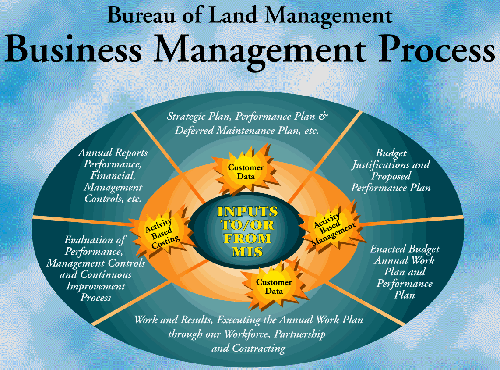
Integrate With the Budget Process
Resources must be allocated on the basis of performance measurement and management. Otherwise, when a choice must be made between doing what is requested in a plan and doing what is needed to keep or obtain funding, the plan will always lose. Your budget must thus be inextricably linked to performance measures.
In Performance Budgeting: Initial Experiences Under the Results Act in Linking Plans With Budget Experiences, General Accounting Office auditors reviewed 35 agencies’ FY 1999 performance plans to determine how well their spending decisions were tied to their performance goals, as required under the Results Act. The agencies with the best practices had performance plans that clarified how resources relate to results and had two things in common. First, these agencies used simple links between activities and goals. Second, they integrated budget justifications with performance plans.
A number of our study partners used different approaches in linking data to results, though none were entirely comprehensive. Our partners’ best practices in the area of linking budgets to performance measurement include the following:
- Virginia’s performance budgeting process fully integrates strategic planning and performance measurement with agency and program budgeting—and represents a major evolution in the state’s decade of efforts in this arena. By integrating these three elements into a single process, Virginia has been able to link agency mission, program priorities, anticipated results, strategies for achieving results, and budgeting. The state’s performance budgeting process begins with a comprehensive strategic assessment in which each state agency analyzes its state and federal mandates; customers and customer service; agency mission and activities; organizational strengths, weaknesses, threats, and opportunities; and the critical issues it faces. Based on these analyses, each agency then develops strategies, goals, and objectives that constitute its strategic plan.
- In Missouri, two benchmarking partners, the state and its Department of Natural Resources, have worked to develop a strong link between their strategic planning and budget efforts. Simply put, budget requests flow from needs identified in strategic plans. Performance measures are an essential component of the budget forms used by agencies to justify existing funding and to develop requests for additional resources. Agencies must provide information on three levels of performance measures, thus making performance information a vital factor in justifying budget requests and in executive and legislative branch funding decisions.
- The Natural Resources Canada performance measurement framework includes one set of goals, objectives, and draft performance indicators. The framework provides the foundation for all departmental planning and reporting documents. It addresses reporting and performance requirements of the department’s sustainable development strategy, federal science and technology strategy, and internal management practices. The department is currently allocating its financial resources according to the goals contained in the framework and has received special authorization from Parliament to align its budget requests to its strategic goal areas. These strategic goals are cascaded to subordinate components to align budget request and operational plans.
The U.S. Postal Service initiated the "Catch Ball Practice" (referring to the fact that, in performance management, someone is always focused on achievement of a particular goal: the ball is never dropped). For the USPS, there is a level of performance expectation for each USPS business unit; in their turn, each business unit responds with a budget requirement. Through this iterative process, a budget is developed. The unit’s performance measures that result from this planning process reflect the voices of the employees, customers, and business results. As a result, USPS creates a linkage between strategic planning and operational deployment of performance measures. This technique is a top-down and bottom-up internal negotiation and involves the entire organization in the process. Network Two of the Veterans Health Administration also uses the Catch Ball Practice to involve its employees in continual refinement of its Goalsharing Program.
Strategic Management Framework: Departmental Integration
If all of the above—employees, customers, data, budgets, and results—are connected, you are well on your way toward having in place a successful strategic management framework. Such a framework creates an organization where achievement of a stated mission is clearly communicated throughout the organization and where everyone works toward the same goals and objectives. The U.S. Coast Guard and the Department of Veterans Affairs have excellent examples of strategic management frameworks.
- The U.S. Coast Guard’s Family of Plans illustrates the agency’s strategic planning and strategic management architecture, and has been recognized by the General Accounting Office as a best practice in strategic linkage. The architecture supports and institutionalizes the agency’s measurement framework. The family includes the Coast Guard 2020 vision statement, the agency’s strategic outlook, commandant’s direction, and strategic plan. The strategic plan guides and directs (1) the agency performance plan and related annual budget request, (2) operational and support business plans, and (3) plans covering special areas such as human resources and information technology. The field-produced regional strategic assessments provide input to the formulation of the strategic plan and directorate business plans.
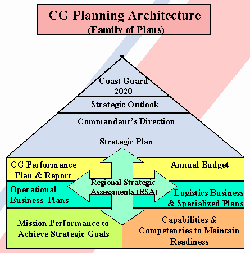
- The VA’s Strategic Plan, FY 1998-2003, is grounded in the notion of "One VA" that "delivers seamless service to veterans and their dependents." To this end, the department is restructuring the strategic planning and programs of its component elements (the Veterans Health Administration, VBA, and National Cemetery Administration) to function as a unified whole. Using state-of-the-art planning techniques, the department is creating a strategic planning process that will build a strong and resilient strategic base for the future. Key components of that planning process include developing
- measures of program efficiency (unit cost),
- measures of program outcomes,
- information systems that ensure that management data are available for each measure,
- benchmark levels of performance,
- mechanisms to link performance measurement to the budget, and
- mechanisms to link organizational goals and performance with individual employee goals and performance.
Section 5: Sharing the Leadership Role
A boss creates fear, a leader confidence. A boss fixes blame, a leader corrects mistakes. A boss knows all, a leader asks questions. A boss makes work drudgery, a leader makes it interesting. A boss is interested in him or herself, a leader is interested in the group.—Russell H. Ewing
Without exception, our partners (both best practice and resource) have cited strong leadership as a key factor in their success in applying a balanced approach to performance management. Without support from senior management and top officials, it is difficult—although not impossible—to establish a successful strategic framework that integrates all the factors discussed in this report.
Whether an organization’s management structure is—like Canada’s St. Lawrence Seaway Management Corporation—a pyramid or more like a web— characterized by interconnections criss-crossing throughout the structure—certain leadership truisms pertain These are: (1) good leadership relies on good communication, and (2) all members of the organization must have clearly defined responsibilities. The best leaders
- report back to the employees, customers, and other stakeholders;
- use self-assessment tools, such as the Baldrige criteria;
- involve the legislative branch through consultation or representation on working groups and committees;
- involve the customer, stakeholder, and employee at every phase of the management process; and
- involve the unions early and often.
Leadership that takes into account feedback from its employees, customers, and stakeholders, together with performance data, has a full scope of information upon which to make informed decisions. And it is a basic tenet of good management that the more informed the decision, the sounder that decision will be.
It verges on paradoxical that a good leader must be a catalyst that institutes a culture that will survive changes in leadership and administration. The key here is to cascade leadership throughout an organization, and to give ownership of strategic plans and performance measures to career employees. That ownership, which involves organizational learning and culture change, is necessary for sustainability.
If the leadership of a public sector organization works—as defined above—it will result in support for organizational initiatives both internally and externally:
- Internally, ownership will be given to the employees, allowing each one to be a leader within his or her own sphere. For example, the Canadian St. Lawrence Seaway Management Corporation organizes its performance indicators according to a clearly delineated pyramid. All employees know where they fit into the structure and what they are expected to achieve.
- Externally, support may be gleaned from the legislative branch, especially if you make them partners in the process. Texas, Missouri, Iowa, and Natural Resources Canada all consult extensively with their legislative bodies when developing their priorities.
- Public support will also be created because the customer has been allowed input into what is needed and how best to deliver it. All our partners include their customers in their planning activities and report back to them through published reports and/or the Internet.
Top-level support in successfully establishing a balanced set of measures can be seen in numerous organizations where this strong executive leadership has cascaded throughout the organization:
- The Internal Revenue Service has worked diligently over the past year to establish a balanced set of measures; its dedication to creating such a performance measurement system stems directly from its commissioner, Charles O. Rossotti. Commissioner Rossotti made a commitment to redirect the IRS’s focus from internal processes to the customer, and major strides have been made in this direction.
- At the Veterans Benefits Administration, the current Under Secretary for Benefits, Joe Thompson, provides strong leadership to the process. He had a positive experience with a balanced set of measures at VBA’s New York office and felt strongly about applying this approach to all of VBA.
- U.S. Coast Guard Commandant James Loy has made performance measurement an imperative of his tenure. He requires his service to use quantitative performance data in the stewardship and management of its resources to provide the "greatest public good" outcome.
- One of the critical success factors in performance management for the National Aeronautics and Space Administration’s Langley Research Center is the fact that the center’s current director, Dr. Jeremiah F. Creedon, was one of the staff people involved in creating the center’s balanced set of measures. The experience of having helped create the initial framework gives Dr. Creedon a clear understanding of the direction desired by the organization, as well as first-hand knowledge of customer and stakeholder input.
- The Missouri Department of Natural Resources cites state Governor Mel Carnahan as one of the key enablers in the development of its performance measurement system.
- Performance-based management has been a major part of the successful organizational changes led by Dr. Kenneth Kizer, Under Secretary for Health (1994-1999), at the Department of Veterans Affairs.
Balancing Measures: Next Steps
What are the next steps in terms of developing and using a balanced set of measures within public sector agencies? Well, whatever agencies decide to take as their next steps in this area, we do know a few things. First, there is no uniform approach that will work for every organization—each agency must develop its own version of a balanced set of measures, tailored to its mission and organizational culture. Second, while each agency is a little different in these respects and requires a unique adaptation of a balanced set of measures, we can learn from each other what works best in certain environments.
Third, the study team began to discern a continuum of progress toward a balanced process for performance measurement. This continuum begins with agencies’ first efforts to engage in performance measurement, which usually focuses on what we do—primarily output, activity, or work-related measures. The next stage moves toward more outcome-oriented measures, recognizing the need to measure impact or results. Most federal agencies are at this stage now as they struggle to implement the Government Performance and Results Act—and achieve their mission or business results. The next stage in this evolution toward applying performance measures in a balanced manner is recognition of the importance of the organization’s learning and growth (or employee) perspective and the customer perspective, in addition to achieving business results. High-performing results-based management organizations in the private sector have been working not just on financial, but also on internal business, customer, and employee perspectives, after realizing that world-class organizations are built of world-class employees.
The renewal of efforts to conduct effective strategic planning and performance measurement in the federal government with the enactment of GPRA in 1993 creates new opportunities and obligations to learn from the private sector, which has had considerable experience in applying a balanced set of measures. This renewal of interest among federal agencies also creates an extraordinary opportunity to learn from each other. We hope that this report conveys, at least in a cursory fashion, the significant opportunities and potential for productive exchanges of information, expertise, and experience about what works as we attempt to apply performance measures in a balanced manner. This productive opportunity to share best practices is an excellent challenge that could be leveraged by emerging communities of practice for results-based management in the public sector.
Specific Actions
The following next steps are identified as specific actions that could be taken by a number of key entities:
- The Office of Management and Budget could supplement its existing A-11 Guidance for GPRA implementation with guidelines that encourage agencies to consider the application of a balanced set of measures—and could provide significant discretion to the agencies about the types of measures and how to balance them.
- The National Partnership for Reinventing Government, or another sponsoring entity, could host a website that would serve as a continuing means for communicating best practice information about balancing sets of measures.
- The General Accounting Office could conduct a review of agency efforts to date to apply a balanced set of measures, and could make recommendations to Congress about promising emerging practices for different types of agencies.
- Key congressional authorizing, oversight, or appropriations subcommittees or committees could examine the use of a balanced set of measures by a particular agency or set of agencies.
- Agencies that have not yet considered applying a balanced set of measures could engage in benchmarking or other interagency discussions with agencies that have developed experience and expertise, or with private sector organizations.
- Agencies could begin to undertake—more actively and routinely—customer surveys and employee surveys to build baseline information leading to the application of a balanced set of measures.
- Other organizations could conduct follow-up reviews of agency efforts to apply a balanced set of measures and the effectiveness of these efforts in improving performance and trust in government. Examples of such organizations include the National Academy of Public Administration (NAPA), Council for Excellence in Government, American Society for Public Administration, International City/County Management Association, Government Accounting Standards Board, National Association of State Budget Officers, Alliance for Redesigning Government, Pew Charitable Trust, Maxwell School, and Government Executive.
Communities of Practice
Several communities of practice have already emerged around GPRA implementation. These existing communities of practice could expand their purview to encompass balancing measures. Examples of these include the following:
- the Research Roundtable,
- the Natural Resources Performance Management Forum,
- the Office of Personnel Management’s GPRA Interest Group,
- the GPRA Regulatory and Enforcement Group,
- the NAPA Performance Consortium,
- the Budget Officers Advisory Committee,
- the Chief Financial Officers’ Council, and
- the President’s Council on Integrity and Efficiency.
Some of these groups have been active since GPRA enactment, and the degree of interest exhibited in and by these groups has been somewhat uneven in recent years. It is difficult to sustain interagency efforts and interest over a long period of time without significant interest and participation at top levels. Yet, as agencies continue to advance their capacities to undertake more outcome-based goals, the more they are likely to realize the importance of cross-cutting agency efforts. This is where revitalized and new communities of practice will become important—not only to focus on continued Results Act implementation, but to consider and assess the value of applying a balanced set of measures as well.
One mechanism by which agencies can share best practices
and advance the community of practice is benchmarking across
agencies. Benchmarking provides a disciplined way of undertaking
joint efforts to compare best practices across agencies that may
have very similar types of internal business processes, customers,
or employee interactions. The study team learned a great deal about
efforts within other agencies to grapple with similar types of measurement
problems and issues as everyone attempts to proceed toward more
results-based management. As agencies wrestle with different ways
to apply balanced measures in their own organizations, comparing
practices with others could be very beneficial to all involved.
Benchmarking provides a mechanism for a type of mutual selection
process for partners to compare and advance their own individual
capacities—and to advance the community of practice.
Appendices
Appendix A: Scope and Methodology
The National Partnership for Reinventing Government (NPR) solicited participation and members for this study. A core team was formed in February 1999 that mainly included representatives from federal organizations but also some from local government as well. Leaders were selected from among the core team members to head up the study’s three cluster teams—the High Impact Agency (HIA) Team, the State and Local Government Team, and the Regulatory Agencies Team. These teams represented the division of responsibility for public sector organizations that the core team wanted to review for best practices. The core team also agreed to look at the experiences of foreign governments, such as the United Kingdom and Canada. The cluster leaders formed their respective teams, each of which included individuals from many of the resource partners listed in appendix C. The team leaders briefed the core team on cluster activities at weekly meetings.
This was not a formal benchmarking study. Rather, its purpose was to seek out the best practices and lessons learned by public and private sector entities in their performance planning and management. However, while the methodology did not include all the elements of a benchmarking study, the team adopted the Benchmarking Code of Conduct (published by the American Productivity & Quality Center) since it incorporates principles applicable to this study.
The core team met face to face on a weekly basis. After some discussion, it agreed on a study scope: best practices and lessons learned of how organizations develop, deploy, and balance measures to improve organizational performance. The core team developed screening questionnaires to collect initial information from relevant organizations. It also developed a follow-up questionnaire to collect data on those organizations that, based on their responses to the screening questionnaire, were selected as study partners. These data could be gathered either via telephone interviews or site visits. Based on the data, the team members produced a written report for each of the study partners.
Study Scope
The Balanced Measures Study Team investigated and reported on answers to the following questions: How do leading organizations balance their performance measurement among business results, customer service, and, employee satisfaction? More specifically, how do they use their customers, stakeholders, and employees to establish and prioritize performance measures in the strategic planning process? How do successful organizations achieve management and employee "buy-in" to this process? What problems do they encounter in so doing, and how do they address these problems?
The study also entailed an extensive amount of secondary research (see appendix D for the resources consulted). Notably, the core team identified best practices and other key information using ABI/INFORM on CD-ROM and ProQuest Direct®. Team members reviewed and analyzed recent studies and reports from the private, nonprofit, and public sectors on performance measurement; gleaned information from various conferences; and learned from recognized experts such as Carl Thor, Maurice McTigue, and Patricia Ingraham both via telephone conversations and in face-to-face presentations.
Meanwhile, the three cluster teams developed and followed their own individual methodologies in pursuing their objectives. These are described below. The best practices and lessons learned derived from the cluster team efforts were brought to and discussed by the core team as a whole. Throughout this study, the key challenge has been to define what must happen to enable government leaders to manage their work through the use of a balanced set of measures. This report represents the team’s synthesis of best practices and lessons learned in the area of balancing performance measurements.
High Impact Agencies
The HIA Team began by reviewing the principles outlined in Kaplan and Norton’s works, which provide the basic definitions for a Balanced Scorecard, as well as a number of secondary research articles on this facet of performance management prepared by members of the team. The team also examined the systematic application of a balanced set of measures by Xerox Corporation that has been conducting extensive performance measurement for over 17 years. The team met weekly during the course of the study to compare notes and to prepare for site visits. To complete its work, the team broke into separate workgroups by type/category of organizations—service, land (or natural resource) management, regulatory, benefits, research, and general. All 32 of the HIAs were grouped according to these categories.
The HIA Team developed criteria for selection as a site visit partner, and then developed a screening survey based on these criteria. All 32 HIAs were asked to complete the surveys, and all but two responded—several in great detail. Ten HIAs were selected as partners, including two field office units that were part of HIA organizations—Veterans Health Administration Network 2 and the National Aeronautics and Space Administration Langley Research Center. Team members either visited partner sites in person or held detailed teleconferences with the partners. The team conducted all of these surveys using a very detailed questionnaire.
The HIA Team originally developed an approach that would have drawn benchmarking partners from among the HIAs, the private sector, and other public sector agencies. This approach was based largely on the assumption that there was not yet much experience on the part of the HIAs, or any other federal agencies, in applying a balanced set of measures approach. Based on the results of the initial screening survey and subsequent discussions with agency representatives, it became clear that several agencies were very interested in participating in the study and had developed a noteworthy degree of experience in applying a balanced set of measures. The team thus gradually shifted its efforts from the search for private sector organizations as partners when it became clear that (1) a significant number of the HIAs were interested in participating as partners; (2) the team could not also conduct an extensive review of private sector organizations within the limited time available for the study; and (3) the team could glean a number of best practices from the public sector agencies—organizations that had not received the same degree of scrutiny thus far in the secondary literature as had the private sector organizations.
Each site visit was conducted by at least two team members.
State and Local Government
The State and Local Government Team was comprised of senior management officials—drawn from both state and local governments and the nonprofit sector—with successful track records in performance management. Two former government officials with extensive experience as consultants in performance measurement also served on the team. A community of learning evolved among team members as ideas and experiences were exchanged via teleconferences and e-mail, and as reports, literature, and data sets were shared.
The team members first focused on identifying potential study sites. To do so, they reviewed both recent and past studies, including the Maxwell School’s "The Government Performance Project: Grading the States," published in Governing magazine; case studies by the American Society for Public Administration’s Center for Accountability and Performance and the Alliance for Redesigning Government; and benchmarking work by the International City/County Management Association.
The team narrowed down the list based on their interest in learning about the successful experiences of their peers in other cities and states. Thus, the Assistant City Manager of Coral Springs conducted the site study of Austin; the Director of Outcome Measurement at the United Way of America studied Phoenix and Charlotte; and Coral Springs was studied by staff from Fairfax County. For the states, the Texas study was done by a team from the Iowa Department of Management; the Virginia study was done by the Director of Indiana’s Human Resources Council; and Virginia’s Director for Performance Management studied Missouri’s work. The research team as a whole reviewed, critiqued, and asked further questions based on the initial site phone interviews to prepare final site reports.
This "cross-pollination" approach to the site work strengthened the team community of learning and extended it to the sites interviewed. This community of learning continues, as research partners collaborate on problems, challenges, and best practices in performance management.
Regulatory Agencies
The Regulatory Agencies Team members were all from federal regulatory agencies and approached the study with the special orientation such agencies have—a recognition of the challenges of achieving compliance. Following a review of current research in performance, customer service, and management principles, the team came to see that there are issues unique to regulatory agencies that are not found in other agencies, since regulatory agencies have both "compulsory" as well as "voluntary" customers. For example, the U.S. Coast Guard regulates the commercial shipping industry in order to effect progress toward its strategic goal regarding safety. Shipping companies do not choose to be customers, but—because they must comply with Coast Guard regulations, and because Coast Guard activities and performance measures are oriented toward safety—they are "customers." Nevertheless, the compliance of these compulsory customers can be gained voluntarily: Industries can partner with regulators, whether formally or informally, to improve compliance. Health professionals, academia, and other professions often recognize the benefit in regulators’ products and efforts— whether these benefits are protecting public health, enforcing professional standards, or any of the other public good outcomes that judicious regulation can provide.
The team also came to realize that regulatory agencies often serve all citizens, thus making all members of the American public potential customers. For example, any citizen who consumes clean air and safe food uses the services of Environmental Protection Agency or the Food and Drug Administration.
Recognizing that most regulatory agencies currently have well-defined measures for business results only, the team opted to take a "snapshot" rather than a best practices approach to its work. That is, the team looked at how the agencies were conducting their business today, most of which showed strong measurements in acquiring their business results, and at what plans were in process for the future to incorporate performance measures in customer service and employee satisfaction.
The team searched for different agency approaches to common regulatory problems. To accomplish this, it looked for such indicators of regulatory culture change as quality of work-life initiatives, analytical tools, and how the agencies identified and met the needs of employees. The team selected a cross-section of safety, commercial, and environmental agencies to represent a broad range of regulatory missions, sizes, and conventions.
Appendix B: Team Members, Acknowledgments, and Best Practice Partners
Kathleen Monahan, Project Leader
National Partnership for Reinventing Government
Now returned to HUD
Telephone: (202) 708-0614 x3871
E-mail: Kathleen_E._Monahan@HUD.gov
Audrey Borja
Food and Drug Administration (HHS)
Performance Results Staff, Office of Regulatory Affairs
Telephone: (301) 827-4225
Fax: (301) 827-0963
E-mail: Aborja@ora.fda.gov
Jerry Chatham
Department of Veterans Affairs
Telephone: (202) 273-5280
Fax: (202) 273-6629
E-mail: Jerry.Chatham@mail.va.gov
Betsy Currie
Department of Commerce
Telephone: (202) 482-1347
Fax: (202) 482-3361
E-mail: Bcurrie@doc.gov
Stuart Haggard
Department of Veterans Affairs
Telephone: (202) 273-5053
Fax: (202) 273-5993
E-mail: Stuart.Haggard@mail.va.gov
Amy Hertz
Department of Veterans Affairs
Telephone: (202) 273-5283
Fax: (202) 273-6629
E-mail: Amy.Hertz@mail.va.gov
John Kamensky
National Partnership for Reinventing Government
Telephone: (202) 694-0009
Fax: (202) 694-0002
E-mail: John.kamensky@npr.gov
John Keith
Bureau of Land Management (Interior)
Telephone: (202) 452-5159
Fax: (202) 452-5171
E-mail: J55keith@wo.blm.gov
Margo Kiely
Fairfax County, Virginia
Director, Department of Systems Management
for Human Services
Telephone: (703) 324-5638
Fax: (703) 324-7572
E-mail: margokiely@hotmail.com
Curt Marshall
Department of Commerce/Department of Veterans Affairs
Curt Marshall was at Commerce for most of this study. He is now
at VA.
Telephone: (202) 273-7522
Fax: (202) 273-5991
E-mail: curtis.marshall@mail.va.gov
Michael J. Novak
Internal Revenue Service (Treasury)
Telephone: (202) 622-6768
Fax: (202) 622-6767
E-mail: Michael.S.Novak@m1.irs.gov
Website: http://www.irs.ustreas.gov
Valerie Richardson
Patent and Trademark Office (Commerce)
Office of the Comptroller and Deputy Chief Financial Officer
Telephone: (703) 305-8161
Fax: (703) 305-9038
E-mail: Valarie.richardson@uspto.gov
Steve Ruszczyk
National Partnership for Reinventing Government
Telephone: (202) 694-0071
Fax: (202) 632-0390
E-mail: Stephen.ruszczyk@npr.gov
Gene Sheskin
U.S. Customs Office (Treasury)
Telephone: (202) 927-0276
Fax: (202) 927-0276
E-mail: gene.s.sheskin@customs.treas.gov
Ava Singleton
Financial Management Service (Treasury)
Telephone: (202) 874-8780
Fax: (202) 874-7275
E-mail: Ava.singleton@fms.sprint.com
Patti Stevens
Fairfax County, Virginia
Department of Systems Management for Human Services
Telephone: (703) 324-7132
E-mail: Pstevens@co.fairfax.va.us
Bob Stockman
National Weather Service (Commerce)
Telephone: (301) 713-0159
Fax: (301) 713-0161
E-mail: robert.stockman@noaa.gov
Patricia Sun
Federal Railroad Administration (DOT)
Telephone: (202) 493-6060
Fax: (202) 493-6068 (FRA)
E-mail: patricia.sun@fra.dot.gov
Chris Tirpak
Environmental Protection Agency
Telephone: (202) 260-7538
Fax: (202) 260-1096
E-mail: Tirpak.chris@epa.gov
Peter Troedsson (Lt. Commander)
U .S. Coast Guard (DOT)
Telephone: (202) 267-1124
Fax: (202) 267-4401
E-mail: Ptroedsson@comdt.uscg.mil
Janice Warden
National Partnership for Reinventing Government
Telephone: 202-694-0029
Fax: (202) 694-0002
E-mail: Janice.warden@npr.gov
Michael Zack, U.S. Coast Guard (DOT)
Telephone: (202) 267-1137
Fax: (202) 267-4401
E-mail: Mzack@comdt.uscg.mil
Special Thanks
The following individuals provided professional input and gave us the benefit of their extensive knowledge in the field of balancing measures and performance management. We want to thank them for all their time and effort.
- Jake Barkdoll, National Academy of Public Administration
- Jonathan Breul, Office of Management and Budget
- Sharon Caudle, General Accounting Office
- Suma Chakrabarti, Performance and Innovation Unit, UK
- Gloria Craig, Service First Unit, UK
- Dr. Patricia Ingraham, Campbell Institute, Maxwell School, Syracuse University
- Hon. Maurice C. McTigue, Mercatus Center, George Mason University (former New Zealand Cabinet member)
- Chris Mihm, General Accounting Office
- Adel Shalaby, Chief Information Officer Branch, Treasury Board Secretariat, Canada
- Prof. Colin Talbot, University of Glamorgan, Wales, UK
- Dr. Carl Thor, author
Best Practice Partners
Austin, Texas
Charles Curry
City of Austin Budget Office
Telephone: (512) 499-2610
Fax: (512) 499-2617
E-mail: charles.curry@ci.austin.tx.us
Websites: http://www.ci.austin.tx.us/budget98/coacomi.htm
or
http://www.ci.austin.tx.us/news/voice_survey.htm
Bureau of Land Management (Interior)
Carl Zulick
Management Systems Group
Telephone: (202) 452-5155
Website: http://www.blm.gov
Charlotte, North Carolina
Lisa Schumacher
Office of Budget
E-mail: bulbs@mail.charmeck.nc.us
Website: http://www.ci.charlotte.nc.us/cimanager/about1.htm
Coral Springs, Florida
Charles Schwabe
Office of the City Manager
E-mail: cs@ci.coral-springs.fl.us
or
Ellen Liston
Assistant City Manager
E-mail: egl@ci.coral-springs.fl.us
Website: http://www.ci.coral-springs.fl.us/CityHall/cm.htm
Department of Housing and Urban Development
Kathleen Monahan
Office of the CFO/Budget
Telephone: (202) 708-0614 x3871
E-mail: Kathleen_E._Monahan@HUD.gov
Website: http://www.hud.gov
Fairfax County, Virginia
Margo Kiely, Director
Department of Systems Management for Human Services
Telephone: (703) 324-5638
E-mail: Mkiely@co.fairfax.va.us
or
Patti Stevens, Services Integration Manager,
Department of Systems Manage ment for Human Services
Telephone: (703) 324-7132
E-mail: Pstevens@co.fairfax.va.us
Federal Railroad Administration (DOT)
Alex Della Valle
Telephone: (202) 493-6210
E-mail: alex.della-valle@fra.dot.gov
Website: http://www.fra.dot.gov
Federal Trade Commission
Lenore Rodriquez
Telephone: (202) 326-2190
Fax: (202) 326-2329
E-mail: lrodriquez@ftc.gov
Website: http://www.ftc.gov
Florida Department of Environmental Protection
Darryl S. Boudreau
Program Administrator, Strategic Projects and Planning
Telephone: (904) 921-9717
Fax: (904) 488-7093
E-mail: boudreau_d@epic9.dep.state.fl.us
Website: http://www.dep.state.fl.us/ospp
Health Care Financing Administration (HHS)
Elizabeth Richter
Director, Division of Financial Data Analysis
Telephone: (410) 786-7290
E-mail: LRichter@hcfa.gov
Internal Revenue Service (Treasury)
Michael J. Novak
Telephone: (202) 622-6768
Fax: (202) 622-6767
E-mail: Michael.S.Novak@m1.irs.gov
Website: http://www.irs.ustreas.gov
Iowa
Mary Noss Reavely, Department of Management
Council for Human Investment
Telephone: (515) 281-5363
Fax: (515) 242-5897
E-mail: Mary.Reavely@idom.state.ia.us
Kaiser Permanente (Oakland, California)
Deb Lowry
Director, Market Performance Appraisal
Telephone: (510) 271-5879
Missouri
Lori Strong-Goeke
Assistant Director, Office of Administration, Division of Budget
and Planning
E-mail: Stronl@mail.oa.state.mo.us
Websites: http://www.oa.state.mo.us/bp/bp.htm
or
http://www.oa.state.mo.us/bp/bib99/budsum/index.shtml
Missouri Department of Natural Resources
Alice Gellar
Telephone: (573) 522-5530
E-mail: nrgella@mail.dnr.state.mo.us
Website: http://www.dnr.state.mo.us
Langley Research Center (NASA)
Belinda Adams
Telephone: (757) 864-8990
E-mail: b.h.adams@larc.nasa.gov
National Marine Fisheries (Commerce)
Jim Cohen
E-mail: jim.cohen@noaa.gov
Natural Resources Canada
Mark Pearson
Strategic Planning & Coordination Branch
Telephone: (613) 996-6055
E-mail: mpearson@nrcan.gc.ca
Website: http://www.nrcan.gc.ca
Patent and Trademark Office (Commerce)
Valerie Richardson
Senior Advisor to the Comptroller and Deputy Chief Financial Officer
Telephone: (703) 305-8161
E-mail: Valarie.richardson@uspto.gov
Websites: http://www.uspto.gov/web/offices/com/corpplan/index.html
or
http://www.uspto.gov/web/offices/com/annual/index.html
Phoenix, Arizona
Bob Wingenroth
City Auditor
E-mail: bwingenr@ci.phoenix.az.us
Website: http://www.ci.phoenix.az.us/CITYGOV/
St. Lawrence Seaway Management Corporation (Canada)
Carmen Nadeau
Performance Management Coordinator
Voicemail: (613) 932-5170, x3258
E-mail: cnadeau@seaway.ca
Securities and Exchange Commission
Michael Erickson
Financial Management Analyst
Telephone: (202) 942-0347
E-mail: EricksonM@sec.gov
Website: http://www.sec.gov
Social Security Administration
Carolyn Shearin-Jones
Director,
Office of Strategic Management
Telephone: (410) 965-6210
or
Judy Cohen
Leader, Near-Term Planning, Office of Strategic Management
Telephone: (410) 965-2045
E-mail: judy.cohen@ssa.gov
Texas
Ara Merjanian
Group Director for Planning and Development, Governor’s Budget Office
Telephone: (512) 463-1744
E-mail: Amerjanian@governor.state.tx.us
Websites: http://www.governor.state.tx.us
or http://www.lbb.state.tx.us
or http://www.sao.state.tx.us
U.S. Coast Guard (DOT)
Peter Troedsson, Lt. Commander
Telephone: 202-267-1124
E-mail: ptroedsson@comdt.uscg.mil
or
Michael Zack
Strategic Planning Analyst
Telephone: 202-267-1137
E-mail: mzack@comdt.uscg.mil
Website: http://www.uscg.mil
U.S. Postal Service
Patrick Mendonca
Telephone: (202) 268-6070
E-mail: pmendonca@email.usps.gov
VISN 2 (VA/VHA)
Harry Ray
Telephone: (716) 862-6004
Website: http://www.va.gov/visns/visn02/vitalsigns.html
Veterans Benefits Administration (VA)
Dennis Thomas
Telephone: (202) 273-5442
E-mail: ormdthom@vba.va.gov
Veterans Health Administration (VA)
Tony Distasio
Telephone: (202) 273-8939
E-mail: anthony.distasio@mail.va.gov
Virginia
Herb Hill
Director of Strategic Planning, Research and Evaluation
Telephone: (804) 786-8813
Fax: (804) 786-4472
E-mail: Hhill@dpb.state.va.us
Website: http://www.state.va.us/dpb
Appendix C: Resource Partners
The team did not make site visits to the following organizations, which did, however, contribute significantly to the study’s findings, either by responding to the team’s survey questionnaire or by sharing their experiences in this area. Their contributions provide much depth to this report.
Administration for Children and Families (HHS)
Mary Ann MacKenzie
Telephone: (202) 401-5272
E-mail: ml@acf.dhhs.gov
Animal Plant Health Inspection Service (USDA)
Eva Ring
Telephone: (301) 734-3582
E-mail: eva.p.ring@usda.gov
Atomic Energy of Canada, Ltd.
Mike Whitfield, Manager, Internal Audit
Telephone: (613) 584-8811
Fax: (613) 584-8040
E-mail: whitfieldm@aecl.ca
BJC Health System
Kristi Short
Director, Strategic Planning
Telephone: (314) 286-2149
Bureau of the Census (Commerce)
Joe Bellomo
Telephone: (301) 457-2327;
E-mail: joseph.p.bellomo@ccmail.census.gov
Camcare
Brenda Grant
Corporate Director, Community and Corporate Health
Telephone: (304) 348-1006
E-mail: brenda.grant@camcare.com
Department of Defense
William E. Mounts
Telephone: (703) 614-3882
E-mail: mountsw@acq.osd.mil
Department of Energy
Steve Logan
Telephone: (202) 586-9048
Website: http://www.pr.doe.gov/bsc001.htm
Environmental Protection Agency
Josh Baylson
Telephone: (202) 260-3644
E-mail: baylson.joshua@epa.gov
Federal Aviation Administration Logistics Center
(DOT)
Rosalie Manley
Telephone: (202) 267-3009
Federal Deposit Insurance Corporation
Gordon Goeke, Analyst
Telephone: (202) 416-4067
E-mail: Gogoeke@fdic.gov
Website: http://www.fdic.gov
Financial Management Service (Treasury)
Corvelli McDaniel
Telephone: (202) 874-7100
E-mail: corvelli.mcdaniel@fms.sprint.com
Food and Drug Administration (HHS)
Paul Coppinger
Telephone: (301) 827-5292
E-mail: pcopping@test.oc.fda.gov
Food and Nutrition Service (USDA)
Boyd Kowal
Telephone: (703) 305-2130
E-mail: boyd.kowal@fns.usda.gov
Food Safety and Inspection Service (USDA)
A. Charles Danner
Telephone: (202) 501-7136
E-mail: charles.danner@dchqexs1.hqnet.usda.gov
Forest Service (USDA)
Kathy Maloney
Telephone: (202) 205-1031
E-mail: kathy.maloney/wo@fs.us
General Accounting Office, San Francisco
Sharon Caudle
Telephone: (415) 904-2280
E-mail: Caudles.sfro@gao.gov
General Services Administration
Rich Gudaitis
Telephone: (202) 501-1037
E-mail: rich.gudaitis@gsa.gov
Immigration and Naturalization Service (DOJ)
Paul Astrow
Telephone: (202) 305-4155
E-mail: paul.w.astrow@usdoj.gov
Indiana Human Resources Investment Council
Tim McGann
Telephone: (317) 233-0565
Fax: (317) 233-3091
E-mail: tmcgann@hric.state.in.us
Learning University, Minneapolis Campus (VA)
Kurt C. Gundacker, Trainer
Telephone: (612) 725-2160
Fax: (612) 725-2053
E-mail: GundackerKur@lrn.va.gov
Massachusetts Department of Environmental Resources
Carol Rowan West
Director, Office of Research and Standards
Telephone: (617) 292-5510
E-mail: Carol.Rowan.West@state.ma.us
Website: http://www.state.ma.us
National Academy of Public Administration
Performance Measurement Consortium
Jake Barkdoll
Telephone: (301) 987-8596
E-mail: jakebarkdoll@msn.com
National Aeronautics and Space Administration
Judy Tenney
E-mail: Judy.tenney@hq.nasa.gov
National Park Service (Interior)
Heather Huyck
Telephone: (303) 987-6770
E-mail: heather_huyck@nps.gov
National Weather Service (Commerce)
Bob Stockman, Strategic Planner
Telephone: (301) 713-0159
Fax: (301) 713-0161
E-mail: robert.stockman@noaa.gov
Nuclear Regulatory Commission
Richard R. Rough
Director, Division of Planning, Budget, and Analysis
Telephone: (301) 415-7540
E-mail: RRR@nrc.gov
Website: http://www.nrc.gov
Occupational Safety and Health Administration
Paula White, Director of Federal State
Operations
Telephone: (202) 693-2200
E-mail: paula.white@osha.no.osha.gov
Office of Personnel Management
Mary Strand
Telephone: (202) 606-1704
E-mail: mastrand@opm.gov
Passport Services, Bureau of Consular Affairs
(State)
Liz Soyster
E-mail: Soystereb@state.gov
Performance and Innovation Unit (UK)
Darren Welch
Telephone: 44-171-270-1514
Fax: 44-171-270-1568
E-mail: dwelch@cabinet-office.x.gsi.gov.uk
Public Service Company of New Mexico
Janet Ruggles
Telephone: (505) 241-2594
E-mail: jruggle@mail.pnm.com
Service First Unit (UK)
Gloria Craig, Deputy Director
Telephone: 44-171-270-6255
Fax: 44-171-270-5824
E-mail: gcraig@cabinet-office.gov.uk
Website: http://www.servicefirst.gov.uk
Small Business Administration
James Van Wert
Telephone: (202) 205-7024
E-mail: james.vanwert@sba.gov
St. Cloud Hospital
Mary Buhl
Director, Performance Improvement/Risk Management
Telephone: (320) 255-5780
Student Financial Services (Education)
Cyndi Reynolds
Telephone: (202) 708-9248
E-mail: cyndi_reynolds@ed.gov
Trademarks Office (Canada)
John Rombouts, Senior Advisor
Telephone: (819) 953-4746
Fax: (819) 997-1421
E-mail: rombouts.john@ic.gc.ca
United Way of America
Charlie Bennett
Director, Outcome Measurement Implementation
Support
Telephone: (703) 836-7112
Fax: (703) 549-9152
Email: charles.bennett@uwa.unitedway.org
U.S. Customs Office (Treasury)
Harry Carnes
Telephone: (202) 927-0275
E-mail: harry.carnes@customs.treas.gov
U.S. and Foreign Commercial Service (Treasury)
Richard M. Irving
Telephone: (202) 482-3304
E-mail: d.irving@mail.doc.gov
VISN 9, MidSouth Healthcare Network (VA)
Janice Cobb, RN
Quality Management Officer
Telephone: (615) 340-2389
E-mail: Janice.Cobb@med.va.gov
Marv Weidner
Formerly with Iowa Department of Management;
now working with city of Austin, Texas,
on performance management issues
Telephone: (515) 282-4743
Fax: (515) 282-5933
E-mail: mweidner@cinetserv.com
Appendix D: For More Informationa
Websites and Databases
American Society for Public Administration, Center for Accountability and Performance (CAP), CAP Case Studies
Case Studies of Government Reinvention
(Iowa, Texas, Coral Springs, Phoenix)
City of Indianapolis and Marion County, Indiana
Federal Electronic Commerce Program Office
Inter-Agency Benchmarking & Best Practices Council
International City/County Management Association
National Academy of Public Administration, Center for Improving Government Performance
National Partnership for Reinventing Government
Office of Governmentwide Policy
Partners in Technology Excellence—Exploring the Management, the Use and the Impact of Information in the Knowledge-Based Society
ProQuest Direct®: Search under best practices, benchmarking, balanced scorecard, balanced measures, performance measures, performance management, strategy, strategic management, etc.
Treasury Board of Canada Secretariat
Articles
Katherine Barrett and Richard Greene. 1999. "The Government Performance Project: Grading the States—A Management Report Card." Governing Magazine, February.
Wendy Bleiweiss. 1998. "Measuring What Counts: Performance Measurement Can Make Carriers More Competitive." Telephony, October 16, pp. 51-52.
John C. Camillus. 1996. "Reinventing Strategic Planning." Strategy & Leadership, May/June, pp. 6-12.
Sharon L. Caudle. 1998. "Reengineering: Avoiding Becoming Lost in Space (Reengineering of Government Organizations)." The Public Manager: The New Bureaucrat, Vol. 27, No. 1 (Spring), pp. 27-30.
Georges Enderle and Lee A. Tavis. 1998. "A Balanced Concept of the Firm and the Measurement of Its Long-Term Planning and Performance." Journal of Business Ethics, Vol. 17, pp. 1129-44.
Philip B. Evans and Thomas S. Wurster. 1997. " http://www.hbsp.harvard.edu/products/hbr/sepoct97/97504.html">Strategy and the New Economics of Information." Harvard Business Review, September/October 1997.
Michael Gaiss. 1998. "Enterprise Performance." Management Accounting, December, pp. 4446ff.
Gay Gooderham. 1998. "Power Tool: How to Overcome the Barriers to the Balanced Scorecard." CMA Magazine, September, p. 11.
Mara E. Hacker and Paul Brotherton. 1998. "Designing and Installing Effective Performance Measurement Systems." IIE Solutions, August, pp. 1823ff.
Greg Hackett. 1998. "Benchmarking Your Planning and Reporting Function." Financial Executive, September/October, pp. 45-46.
Jeremy Hope and Robin Fraser. 1999. "Beyond Budgeting: Building a New Management Model for the Information Age." Management Accounting, January, pp. 16-21.
A.C. Hyde. 1998. "The Balanced Score Card—Moving Above the Bottom Line." The Public Manager: The Bureaucrat, Vol. 27, No. 3 (Fall), pp. 57-59.
Robert S. Kaplan and David P. Norton. 1996. "Using the Balanced Scorecard as a Strategic Management System." Harvard Business Review, January/February, pp. 75-85.
Mary Kopcznski and Michael Lombardo. 1999. "Comparative Performance Measurement: Insights and Lessons Learned from a Consortium Effort." Public Administration Review, Vol. 59, No. 2 (March/April), pp. 124-34.
Wendy Leavitt. 1998. "Technology and Profit: Crunching More Than the Numbers." Truck.com, October, pp. 51-55.
Pegi Panfely and Leigh-Ann Sonnier. 1996. "Learning From Best Practices in Strategic Planning." Strategy & Leadership, September/October.
Beryl A. Radin. 1998. "The Government Performance and Results Act (GPRA): Hydra-Headed Monster or Flexible Management Tool?" Public Administration Review, Vol. 58, No. 4 (July/August), pp. 307-16.
Robert Sharma. 1998. "Management Accounting: Where to Next?" Australian CPA, December, pp. 24-25.
Malcolm Smith. 1998. "Measuring Organisational Effectiveness." Management Accounting, October, pp. 34-36.
Pamela Syfert, et al. 1998. "Charlotte Adapts the ‘Balanced Scorecard.’" American City & County, October, p. 32.
Don Tapscott. 1997. "Strategy in the New Economy." Strategy & Leadership, November/December, pp. 8-14.
Lakshmi Tatikonda. 1998. "We Need Dynamic Performance Measures." Management Accounting, September, pp. 49-53.
Nigel Williams and Owen Young. 1998. "The Capital Investment Maze." Banking Strategies, May/June, pp. 63-69.
Robert Wise. 1997. "The Balanced Score Card Approach to Strategic Management." The Public Manager: The New Bureaucrat, Vol. 26, No. 3 (Fall), pp. 47-50.
Books, Handbooks, and Reports
American Productivity & Quality Center. 1997. Reinventing Strategic Planning for a Dynamic Environment. Houston.
Chris Ashton. 1997. Strategic Performance Measurement. London: Business Intelligence. ISBN 1-898085-25-0.
Christopher E. Bogan and Michael J. English. 1996. Benchmarking for Best Practices: Winning through Innovative Adaptation. New York: McGraw-Hill. ISBN 0-07-006375-3.
Stanley A. Brown, ed. 1997. Breakthrough Customer Service: Best Practices of Leaders in Customer Support. New York: John Wiley & Sons. ISBN 0-471-64232-0.
Robert C. Camp. 1989. Benchmarking: The Search for Industry Best Practices that Lead to Superior Performance. New York: Quality Resources. ISBN 0-87389-058-2.
James Creelman. November 1998. Building and Implementing a Balanced Scorecard. ISBN 1-898085-40-4.
Peter F. Drucker. 1999. Management Challenges for the 21st Century. New York: Harperbusiness. ISBN 0-88730-998-4.
———. 1993. Post-Capitalist Society. New York: Harperbusiness. ISBN 0-88730-661-6.
General Accounting Office. March 1998.
———. GPRA Best Practices Report. AIMD-96-118.
———. February 1997. Assessing Risks and Returns: A Guide for Evaluating Federal Agencies’ IT Investment Decision-Making. GAO/AIMD-10.1.13.
———. January 31, 1997. Managing Technology: Best Practices Can Improve Performance and Produce Results. GAO/T-AIMD-97-38. Testimony by Christopher W. Hoenig, Director, Information Resources Management Policies and Issues, before the National Commission on Restructuring the Internal Revenue Service.
———. April 1999. Performance Budgeting: Initial Experiences Under the Results Act in Linking Plans With Budgets. GAO/AIMD/GGD-99-67.
H. James Harrington. 1996. The Complete Benchmarking Implementation Guide: Total Benchmarking Management. New York: McGraw-Hill. ISBN 0-07-006375-3.
Robert S. Kaplan and David P. Norton. 1996. The Balanced Scorecard: Translating Strategy into Action. Cambridge, MA: Harvard Business School Press. ISBN 0-87584-651-3.
George Labovitz and Victor Rosansky. 1997. The Power of Alignment: How Great Companies Stay Centered and Accomplish Extraordinary Things. New York: John Wiley & Sons. ISBN 0-471-17790-3.
Jean Lave and Etienne Wenger. 1991. Situated Learning: Legitimate Peripheral Participation. Cambridge, UK: Cambridge University Press. ISBN 0-521-4 2374-0.
National Partnership for Reinventing Government. February 1997. Serving the American Public: Best Practices in Customer-Driven Strategic Planning. Federal Benchmarking Consortium Report. Washington, DC.
———. June 1997. Serving the American Public: Best Practices in Performance Measurement. Benchmarking Study Report. Washington, DC.
Don Tapscott. 1996. The Digital Economy: Promise and Peril in the Age of Networked Intelligence. New York: McGraw-Hill. ISBN 0-07-062200-0.
Don Tapscott, Alex Lowy, and David Ticoll, eds. 1998. Blueprint to the Digital Economy: Creating Wealth in the Era of E-Business. New York: McGraw-Hill. ISBN 0-07-063349-5.
Carl G. Thor. 1998. Designing Feedback: Performance Measures for Continuous Improvement. Crisp Publications. ISBN 1-56052-468-5.
Gregory H. Watson. 1993. Strategic Benchmarking: How to Rate Your Company’s Performance Against the World’s Best. New York: John Wiley & Sons. ISBN 0-471-058600-5.
Gregory H. Watson, ed. 1992. The Benchmarking Workbook: Adapting Best Practices for Performance Improvement. Portland, OR: Productivity Press. ISBN 1-56327-033-1.
Etienne Wenger. 1998. Communities of Practice: Learning, Meaning, and Identity. Cambridge, UK: Cambridge University Press. ISBN 0-521-43017-8.
Legislation
Executive Order 12862: Setting Customer Service Standards, September 11, 1993.
Government Performance and Results Act of 1993, Public Law 103-62.
Information Technology Management Reform Act of 1996 (also known as the Clinger-Cohen Act), Public Law 40 U.S.C. 1424.
Presidential Memorandum for Heads of Executive Departments and Agencies: Improving Customer Service, March 23, 1995.
Appendix E: Acronyms
|
BLM |
Bureau of Land Management |
| BOP | business and operating plan |
| DOJ | Department of Justice |
| DOT | Department of Transportation |
| FRA | Federal Railroad Administration |
| FTC | Federal Trade Commission |
| GIS | geographic index system |
| HHS | Department of Health and Human Services |
| HIA | High Impact Agency |
| HUD | Department of Housing and Urban Development |
| MIS | management information system |
|
NAPA |
National Academy of Public Administration |
|
NASA |
National Aeronautics and Space Administration |
| NPR | National Partnership for Reinventing Government |
| POA | Program for Objective Achievement |
| SES | Senior Executive Service |
| USDA | U.S. Department of Agriculture |
| VA | Department of Veterans Affairs |
| VBA | Veterans Benefits Administration |
| VHA | Veterans Health Administration |
| VISN 2 | Veterans Integrated Service Network |
